Moved into new house: Check.
Switched utility suppliers: Check.
Found new internet provider: Check.
Castrated unhelpful TalkTalk employees: Check.
Finally uploaded Episode 13 of the Hansard Series: Freakin’ CHECK!
I know it’s taken a long time, but it’s finally here. That was a ridiculous cliffhanger to be left on, wasn’t it? Everyone’s stranded in the Nether, Ang’s dying, Hansard and Jo are in mortal peril, something BIG is about to happen . . . sorry for the wait. The upside is that because Episode 13 was sitting on my laptop for so long, I’ve been tinkering with it for ages and it just kept growing – so it’s a good 2000 words longer than a normal episode. And it’s a fairly tasty installment: we get the first real insight to part of Hansard’s past; we finally find out what happened to Ang; and could it be that Baines and Grayle are involved somehow?
Furthermore, to help make up for the month-long silence, I’ve got some extra doo-dads to show you on the blog, including some bonus short stories and an interview with an author-friend of mine.
For anyone who may have been expecting Episode 13 of the Jack Hansard Series to go up today, I’ve got bad news for you. The next update is going to be delayed until I have access to internet at my new house. Happily, the house move itself was successful (yay!). Sadly, the internet switch was lost to the bowels of some bureaucratic hell within the offices of TalkTalk (boo!). May those responsible be accosted by the fluffiest of nightmares.
This frustrated update coming to you from my very nice friends who are allowing me an evening to do such boring things as pay my bills, check my emails, and most importantly, change my internet provider. Should be set up by the end of the month. See y’all again soon!
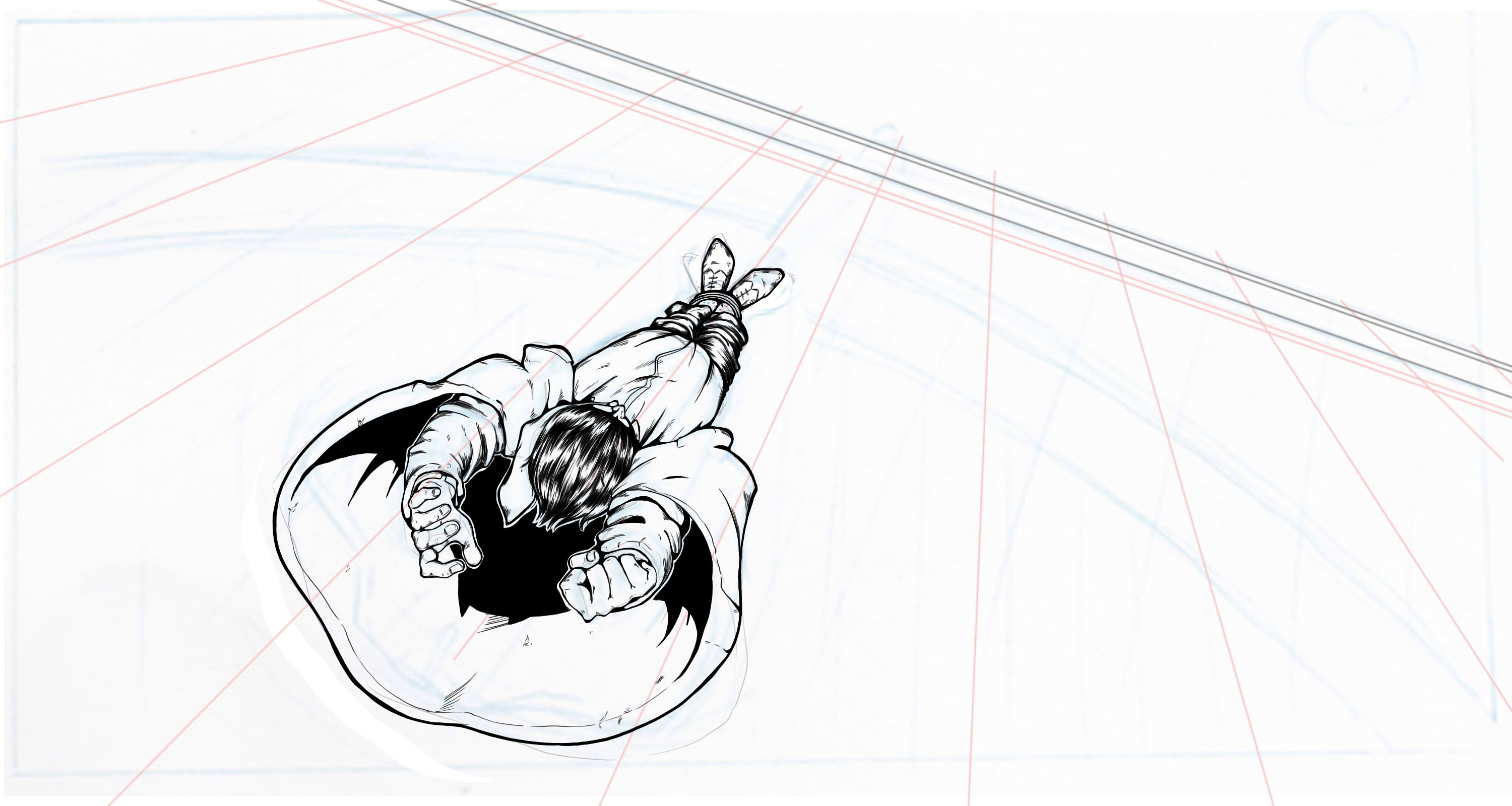
P.S. To make up for the lack of Hansard, here’s a sneak-peak from artist Dom Lane. This is the WIP of the title image fro Epsiode 1. (I’ve seen the finished image. It looks EPIC.)
The red fuel light blinked at me accusingly. I grimaced.
“I suppose it was a bit fast. Sorry about that. I’ll take the ticket and be on my way, shall I?”
I tried to surreptitiously knock the pile of other unpaid vehicular fines off the passenger seat.
“I’ll need to see the license, sir,” the police officer said suspiciously. Her eyes surveyed me and my scruffy attire, then moved to the tattered maps spread across the dashboard and the half-finished bag of yesterday’s chips nestled in the open glove box.
I hoped she wasn’t going to try and search the car. I really didn’t want her to find the body in the boot.
It’s been a while since we last saw Hansard at the Black Market gathering in Hull (where he was picking a fight with fellow traders and desperately trying to find more information on the girl with the quiet eyes) and it seems that he’s had plenty of time to find more trouble since then. In this week’s episode he’s held up by a run-in with the law – and this is bad news for the unfortunate police officer who tries to arrest Hansard. They probably don’t train recruits on how to deal with being pulled into another dimension at the academy.
As always, feedback and constructive criticism welcome. I had a lot of fun writing this one, so I hope you have fun reading it 🙂
Next series update will be Wednesday 22nd of July.
The world is full of thunder, though there isn’t a rain cloud in sight. You see the cannons before you hear them: a silent plume of fire and smoke, followed by the booming shock wave that sweeps across the battlefield, travels up my legs and rattles the shako on my head.
Behind us, our own guns return fire.
Boom.
One of the Korporals has delighted in telling me, over and over, “Y’don’t see a battle. Y’hear it.” A sentiment which I understand to have originated from an officer of the 95th. And now I understand what it means. The white smoke drifts across the field like a thick fog. It passes in font of our battalion and for solid minutes we cannot see more than six feet ahead, let alone the French soldiers lined up on their ridge.
“Here comes Nosey!” shouts our Feldwebel. We turn smartly and stand to attention as Wellington rides by. Rumour has it that Bony was sighted holding afternoon tea on the other side of the field. Will we catch a glimpse of him before the day is out? He’s out there somewhere, hiding in those lines of French. Over two thousand of them, all lined up on their ridge, and us on ours, and all the while our guns are firing.
When the smoke thins there is no longer a line, but a column of French, at least ten ranks deep and advancing towards us in marching step.
Our boys ready their muskets and the order to fire is given. The sound is a crack through the air, and it cascades down the line in a rolling surge of smoke and flame. Another volley is called. Crack. Another, and another, and still the cannons boom behind us, and still the French advance.
The smoke thickens again – I am surprised to find it smells heavily of eggs. It clings to my throat, makes the very air feel heavy and grey. High above, fantastic smoke rings curl lazily against the sky, while on the ground the clouds crawl sluggishly around us.
And out of the clouds come the French.
“Fix bayonets!” comes the desperate call.
The lines clash in a riot of colour and noise and metal. French blue against the black of the Brunswickers to the right, and against the reds and greens of the Highlanders holding firm on the left.
We hang back with the supply wagon, distanced from the fray but hardly out of it. I risk a glance to my right. The same scenes are being played out as the battlefield stretches on, blocks of red fending off blocks of blue, cavalry diving in and out of the melee. The farms of La Haye Sainte and Hougoumont are surrounded; my prayers go to the boys inside.
A shout and sudden chaos: a French horseman has broken through the line and advances towards us, alone. Is he insane?
I dive behind the cart – I am unarmed, but what French would care? Our bodyguard hastily draw their swords and surround us. The horseman isn’t mad after all; perhaps he’s just now realised he’s left his company behind. He turns tail and breaks back through to his own men.
The lines have separated now, the French retreat. Our volleys go into their backs. It’s time to advance.
I’m in position by one of the limbs of the cart, braced and ready. “Auf!” is the command I’m waiting for. We hoist up the cart and drag it forwards, ploughing through the waist-deep grass. It is like wading through prickly mud. Ahead, the army leaves a trampled void of flattened stalks where it passes. It will be easier through there.
At least, it is easier until we reach the bottom of our hill; now we start the climb up the next ridge.
“Halt!” shouts the Feldwebel. He is panting, and so are we. The black uniforms are hot and heavy, and the cloying smoke is still in my lungs. It’s nauseating. As I take a swig from my canteen, I spy the surgeon running towards us. His apron is bloody, and he holds an armful of empty canteens.
We can barely hear him over the roar of the guns, but his mouth frames the word: “Water.” We work as fast as we can, hauling the great jugs off the cart and refilling canteens as fast as possible. Any moment now we’ll be called to advance again, and we can’t afford to be left behind.
There is an almighty crack right beside us, and for just a second the world goes eerily silent save for the ringing tone in my left ear. As sound filters back I spy the culprit, a rifleman dealing with a misfire behind the lines. My muscles relax where they had tensed for flight.
As the surgeon withdraws, he is replaced by a lanky Brunswick Jäger. He doesn’t bother to salute, just opens his cartridge pouch and says with a grin, “Ammo please!” This is a job for the Quartermaster General – even with all that gold braid weighing him down, he’s a practical man to have on the field – the strongbox is unlocked, the black powder cartridges rapidly unloaded, and the Jäger sent on his way.
No sooner has he disappeared into the smoke another officer approaches. We have orders to resupply the Gordon Highlanders to our front and the 42nd to our left. Our relatively quiet corner of the battlefield is suddenly a squall of activity: we can’t pour water fast enough nor assign cartridges with enough speed. We hear that some of the men are completely out of ammunition. We can’t keep up!
And suddenly we are advancing again. With aching muscles we haul ourselves and our cargo up the slope, manoeuvring around bodies of French dead. It is chilling to think that I am walking across a graveyard. The sky overhead has turned an ugly grey.
Peering ahead, I can see a column of French backing away, huddled in on itself, harassed by cavalry and gradually being swallowed by the Highlanders. The Brunswickers advance on, over the ridge and to victory. The French are fleeing.
Our Brunswick motto rings in my ears: Nunquam Retrorsum. Sieg oder Tod.
Never Retreat. Victory or Death.
I look back, and see that we have walked a quarter of a mile from where we began. La Haye Saint lies in ruins; Hougoumont a burning wreck.
I cast my eye over the assembled dead. One of the bodies sits up, and takes a photograph.
The smoke is clearing, the booms and cracks have died away, save for the occasional puff of smoke as someone rids their gun of its last charge. We are approached by a group of weary French soldiers – Imperial Guard, I think – they wear ecstatic grins where terrified faces should be. We offer them some water: it is a long march back to camp, after all.
Bonaparte himself walks by us.
“They’ve left me behind!” he says, comically.
The night is drawing in by the time we leave the battlefield. I won’t reach my tent until midnight, and when I do I shall hit my pillow and sleep like the dead until dawn.
And then tomorrow night, we shall do this all over again.
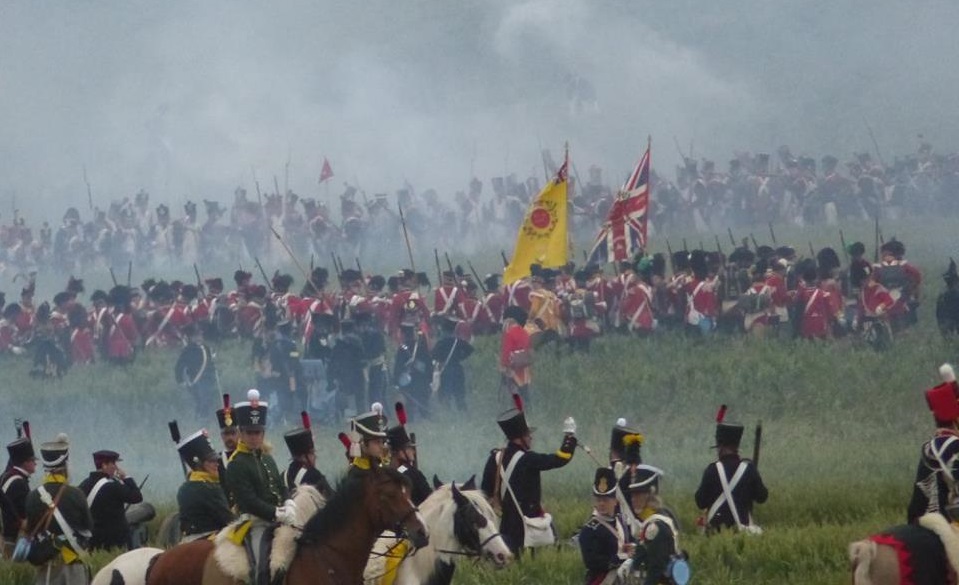
And that, folks, is how I spent my holiday in Belgium – the reason I postponed the next Hansard episode. If you missed the news, it was the 200th anniversary of the Battle of Waterloo, portrayed with around 5000 re-enactors – I’m telling you, it was huge. I didn’t even have to exaggerate most of what is written above. The only real embellishments are the burning of Hougoumont (which happened in real life, but not during this re-enactment) and the order that some of the stuff happens in. It was loud, it was at times terrifying, and it was also awesome in the truest sense of the word.
Impressive and intimidating volleys. I’m one of the small blobs of black next to the bright blue cart on the far right, just behind the line. Photo reproduced with kind permission of Moritz Brehmer.
The sheer sense of chaos is what I will treasure most. There were moments when my commanding officers were practically screaming at us to run into the middle of a square of Allied soldiers because French cavalry appeared to be flanking – because if there’s anything that a small, undefended unit dragging a cart don’t want to face, it’s any kind of cavalry. It was genuinely hard work, but it’s an experience I want to keep logged in my brain in as much detail as possible for future reference. As I was breathing in that strangely egg-flavoured black powder smoke, there was a big portion of my mind thinking, ‘I’ve got to remember how this feels so that if I ever want to write about a big battle with guns I know how to write it . . . ‘
In the thick of it. French advance on the Highlanders while we guard the supply cart just behind. Photo reproduced with kind permission of Jim Moore.
But although that’s the closest I will ever come to experiencing what a real battle might feel like, I am very aware of how vanilla our experiences were – we were spared the gore and the shrieks of pain and the wreckage of a landscape. Most people were wearing a great big grin, like they couldn’t believe they were really there. I couldn’t believe I was really there.
And I couldn’t believe how many people died here, two hundred years ago. I looked out at the massed ranks of both Allied and French soldiers spread out before me, and knocked sections of them down in my head. Boom. You’re dead. Boom. You’re dead.
And at one point I realised: there are only about 5000 of us here. The historic battle suffered over 40,000 dead. I looked at this field filled with people and saw them all littering the ground; every one of us would be dead men. I’m not a praying kind of gal, but I gave my own private homage to the fallen. And of course there was the laying of wreaths and singing of hymns and other little rituals done by each regiment. I’m sure every individual had some little ritual of their own.
I don’t know what those soldiers would have thought of us here in the future, play-acting at what was probably the worst event in their lives. Grim thoughts like that can spoil this hobby, if you let them. The important thing is to temper our fun with respect, and to temper the spectacle with compassion.
Nunquam Retrorsum.
Sieg oder Tod.
Brunswick shako hanging on the surgeon’s tent. Photo reproduced with the kind permission of Pauline Wilmotte.
Apology incoming. I’ve given in, and decided to postpone releasing Episode 10 until next Wednesday. You know what I was saying about life getting in the way? It continued to get in the way. It sounds like a feeble excuse to my ears – after all, there’s always time to write, right?
Definitely. I’ve been eking words out in spare moments at work. I’ve stayed up far too late on days that I shouldn’t in order to eke out some more. I found a few hundred words while squinting at my laptop during the long car journey home yesterday. I even managed about a hundred once I reached home, before the headache kicked in. I got up early this morning to make a last ditch effort on the thing – because better late than never, right? Then I read what I had written, and discovered that it was all a bit shit, and still wasn’t finished. Am I going to be able to correct that in the next two hours before I leave the house again? No.
I realised that over the past fortnight I’ve had very few nights in my own bed. I don’t think I’ve stayed in one place for much more than a day or two; the pile of washing up in the kitchen just keeps growing, and there’s something reminiscent of Hansard’s Odious Miasma living in the bin. I’ve got a couple of hours to deal with some of these things, but then I won’t be back home properly until Sunday night. Ugh. Some of the reasons for this constant movement have been unpleasant (a funeral on my partner’s side of the family, a friend moving away, etc) and some of the reasons have been exceedingly pleasant (such as a friend’s wedding, and a mutual belated birthday gift of a trip to the Harry Potter studios with my sisters – darn worth it, by the way). I’m stubborn as hell, and didn’t want to admit that I might have a teensy bit of trouble getting the latest episode finished on time. Because there’s always time to write, right?
Although I agree with this sentiment, I’ve often wondered how other people achieve it. Because when you say ‘there’s always time to write’ – are we talking about making time, or finding time? They’re two different things, and not equally possible. Ideally, you ‘make’ time by refusing other commitments – you say no to seeing your friends for a day, as an example. But it’s never as easy as that. Even though there’s this cliched image of a writer being in social isolation as a necessary consequence of their work, I’m not sure I believe it. I don’t think I’m an overly special case in that I live too far from friends and family to see them several times a week – there is no twice-weekly pub outing, or the like. But it does mean that social requests are not easily refused. For instance, I could have refused to go my mate’s leaving do, freeing up an entire, valuable evening for writing. But I don’t see him often as it is, and would rather be there to say ‘see ya, good luck, don’t fuck up’. Kinda what friends are for. I could have refused to see my sisters this week, which would have freed up an entire afternoon on Sunday and all of Wednesday. But they’ve paid money to have a week’s holiday near me, and frankly I’ve only seen them twice this year – we’re all skint, so visits are rare.
In my experience, most social commitments are like this. I don’t know if it’s a sign that I’ve become more of an adult, or if it’s just a symptom of moving out of the city (i.e. that place where my friends are) but I find social engagements involve a complex amount of give and take, and they are far more valuable to me now than they were a few years ago. It’s darn difficult to make time by dropping friends and family.
Then there’s finding time, which, if you’re like me, often involves stealing time-sheets from work so that you can write passages on the back of them during your shift. Or fighting the sun as it obscures your view of the laptop in the car. Or sacrificing sleep in exchange for a few more difficult words. This feels easier than making time, because you don’t have to explain it to anyone. You don’t have to let anyone down. Except, I suspect, yourself. The problem with finding time is that really the only person you’re stealing minutes from is yourself. Minutes you should be using to rest, eat, sleep. If you know that you’ve got a long week ahead, if you know you’re going to be hopping between cities and getting less than six hours sleep for several nights in a row, and then still getting up for work in the morning – it’s your own fault for trying to fit in even more work, and burning yourself out by the end of it. Should have made time instead, idiot.
These sound like excuses for why I haven’t met my self-allotted deadline. They’re not meant as excuses – just as observations. Lessons, hopefully. When trying to make or find time it often feels like you can’t win, because everybody else is demanding your time, too. How do you work around that? I’ve read that some people assign one specific day a week as their work day for writing. It’s treated like any other day at work. Friends, girlfriends, boyfriends, spouses, everyone else is told to stay clear, let the writer do their thing in peace. I love the idea, but I’m doubtful about how it works in practice. Regardless of whether you lock yourself away from the world or not, the world comes knocking just to tell you “The washing up needs doing and something might have died in the bin.”
Because even though you view your writing as one of the most important things in the world, few people share that view. I don’t yet think I’m at the point where I could tell a friend: “Sorry, I can’t come see you because writing is more important at the moment.” That sounds like a slap in the face. In my head, the response this gets is along the lines of: “What? Your stupid little short story thing, which isn’t exactly premier literature and nobody reads anyway – this is more important than a day with your friends? This silly, petty pastime is more important than your other hobbies?”
And inside, there’s this meek little voice that just wants to say: “…yes…”
Dang, it all comes down to self-confidence again, don’t it? Like rivers to the sea, follow your problems in writing and it seems they all lead that way. There’s a great big sea of self-trust out there. I’ll reach it, eventually. Ina little boat called Endeavour. Could you get any more twee?
Well, lookee that. I started with an apology and ended up with a piece that vaguely resembles something interesting. To recap: Episode 10 of the Jack Hansard series will be released on the 10th of June, in a suitably more entertaining and well-written state than it currently is.
I ran, crashing wildly through the crowd. Snarls and growls followed in my wake – what’s a few trampled toes and elbowed faces? – I was too intent on my goal to pay them any mind. I reached the spot where I’d seen her, and spun round in desperation.
“Where’d she go?” I shouted, frantically. I threw myself into a nearby cluster of people, certain she must be hiding in amongst them.
“Watch yourself, mate,” said one of the surly men as I broke through.
I grabbed him by the shoulders and practically screamed into his face: “The girl. Did you see her?” With a stunned expression, he dumbly shook his head.
In the latest episode of the Jack Hansard series the search for the quiet-eyed thief intensifies, and Ang receives the affections of an unlikely admirer. A bad decision in the heat of the moment might land them in a whole heap of trouble – but what’s new there?
What’s new here is that there’s new content in the works. The Folklore Snippets are fun to write and I intend to keep writing them, but perhaps to a less rigid structure, allowing me to branch out and experiment whenever the hell I feel like it. If I fancy writing a blog post on Tuesday, but an update isn’t due til Thursday – well, I need to get my head around the idea that are no rules here, because this is my space, so I can damn well put that post up on Tuesday with no explanation. Ditto if life gets in the way so that a supposedly expected blog post is a day late (it did get in the way this week, as it happens – Christ, sometimes it’s like people die on purpose – but the important thing is that I stuck to my promise and the Jack Hansard Episode 9 was on time. Yeah! But sod the blog). I wish I could stop feeling like I have to explain myself every time I decide to do something different – do I fear the judgement of an invisible (and so far silent) audience that much?
Sure, I guess I do. Doesn’t every writer? Wasn’t the whole point of putting my work online to get over that fear and face the judgement of others, silent or otherwise? Wasn’t the whole point, in fact, to build up that self-confidence so I don’t feel the need to ask politely if I can do the thing I want to do, so that I don’t feel like I have to tip-toe around this idea that I like to write things? Why am I embarrassed about that? I need to own that embarrassment, somehow.
I’m getting off-track. Not that there was much of a track to begin with for this post – and frankly I’m finding it quite refreshing. The odd ramble is good for the soul, no?
Anyway, besides all that, there’s something very exciting happening behind the scenes. So exciting, I’ve been bursting to shout about it for weeks, because I’m impatient and want everything to happen at once. An Inspired Mess has been joined by a frankly outstanding illustrator, and we’ve been working hard to bring the Jack Hansard series to life with some shiny pictures! And they are seriously shiny. I wish I could show you all of them, right now – but, like me, you’ll have to wait until they’re finished. Maybe we’ll do a big reveal, Hansard style.
Until then, expect some sneak-peeks of concept art over on the Facebook page, and a formal introduction to our new illustrator here on the blog.
I guess I should go and start working on Episode 10. See ya soon!
Last week’s Episode 8: Black Market featured a couple of interesting new beasties to choose from for this snippet. On the one hand you have Devin Tracey, the charming Irish siren; on the other you have the alluring female huldra. And as I suspect you are least likely to have heard of huldra, she will take the limelight today.
You don’t see much of her in Episode 8, which is a shame, because I think she’s a really characterful creature. She’s of Scandinavian origin, and might be likened to a forest nymph, or a type of troll. She typically looks like a beautiful woman from the front, but from the back you might see her cow tail. If you get to see her bare back, you might find that it is hollow and made of bark, like the dead trunk of a tree.
Now, whenever I do the research for my folklore snippets, I always have the same problem: digging through endless reams of similar but vague descriptions about the creature in question. Yes, unsourced internet article #178, that’s some very interesting information you have there, but it’s no use telling me that: ‘Some stories say…’; or even that: ‘One story from the South of Norway says…’ Which goddamn story, article #178?
What is it called? Who wrote it? Where can I find it?
Ahem.
I found them eventually. A lot of Norwegian folklore was collected by a pair of writers called Peter Christen Asbjørnsen and Jørgen Engebretsen Moe in the 19th century – they are the Scandinavian Brothers Grimm. Huldra apparently feature in a number of these stories, but the problem with Norwegian folktales is that they’re in, well, Norwegian. One great source for an English translation of their work is George Webbe Dasent’s translation of Popular Tales From the Norse – but I haven’t found a story about huldra in amongst these. So instead I’m using Clara Stroebe’s The Norwegian Fairy Book, which features many of the same stories. I’ve picked out two tales which show you some of huldra’s main characteristics:
The Troll-Wife tells the story of how a human man desired a beautiful huldra – she is described as a human-looking troll with a cow’s tail. But she loses her beauty the instant she is captured by this foolhardy man, and he is forced to marry her despite her ugliness. During their wedding ceremony, her tail drops off. At first her husband treats her badly, bitter over her bad looks. The huldra remains well-mannered and even compassionate toward her husband – until one day she shows off her full troll strength by bending metal horseshoes with her hands. Surprise, surprise, her husband is suddenly much kinder to her from that moment onwards.
The Player on the Jew’s Harp is a similar story about a man wedding a huldra maiden, but in this case there is no mention of a cow tail, and she remains beautiful throughout. She is described as being one of the underground folk, known variously as the huldrefolk and ‘the hidden people’. In the story it seems these people cannot be easily seen by human eyes, and they can bewitch other creatures to be hidden as well. The man attracts the huldra’s attention with his skillful playing of the Jew’s Harp (huldra seem partial to beautiful music) and unwittingly captures her by flinging the harp at her head, accidentally drawing blood. Now, in this story a big thing is made of the fact that the huldra is not a Christian. In fact, once they are married, the husband begins to bully her because of this. She ends up displaying her strength in the same way as the Troll-Wife huldra, by bending red-hot horseshoes with her hands. For a while after that the husband is good to her and they prosper. Then his mind darkens, and he goes back to his old ways. One day he beats her, draws blood once more, and she vanishes forever. She doesn’t die; she simply becomes hidden again and spends the rest of her life protecting her husband from her own friends and family, who understandably want to make him pay for his wrongdoings. It’s a very sad tale, made bittersweet by the enduring love of the huldra for her husband. He dies an empty man, full of regret for what he has done.
In both these tales the huldra comes off as a very sympathetic character, but in other tellings she is painted with more cunning motives, actively hoping to trick a human into marrying her so that she may lose her tail and become human herself. If I come across an online English source for these stories, I’ll let you know.
In more modern news, there’s a Norwegian movie about a huldra that I am dying to see: Thale. Fantasy, horror, and my new favourite folkloric creature? Hell yes. Have you seen it? Is it worth spending a whole £8 on? 😛
In the latest episode of the Jack Hansard series, Ang and Jack run into a river-dwelling creature going by the name of Shellycoat. The reason such sprites are given this name should be immediately clear: they wear a rattling coat of shells over their body.
Now, I admit I had some trouble tracking down solid information on Shelly. My first search turned up several sites which all carried the same basic description mimicked by Wikipedia. I don’t wish to become part of the same annoying cycle, but the basic impression is simply: the Shellycoat is Scottish; lives in lakes, rivers and streams; and, like almost every other folkloric creature, has a mischievous nature.
The one solid lead I had was the knowledge that Shelly is mentioned in Jacob Grimm’s (yep, of the famous Brothers Grimm) Deutsche Mythologie. After a rather frustrating time trying to pinpoint the correct volume and page number (vol 2, p.512 in this translation), it turned out to say very little. According to Grimm the Shellycoat is a type of goblin, and he confirms that it is a Scottish creature. He then likens it to a dwarfish thing who wears a bell-coat (which elsewhere I’ve seen called a ‘Schellenrock’ or ‘bell-coat’). The bells worn on the hats and coats of fools are apparently a reference to this ‘shrewd and merry’ goblin.
A more colourful view of the Shellycoat is provided by Walter Scott in his Minstrelsy of the Scottish border (3rd ed), v1, which gives us an idea of the pranks Shelly like to play. Supposedly, he once led two travellers astray by calling out “Lost! Lost!” from the River Ettrick. The travellers followed this sound all night, assuming it to be a drowning person. They followed it all the way to the river’s source, only for the voice to head back down the river, back the way they had come. When they gave up their rescue effort, the Shellycoat revealed himself with laughter and applause, thoroughly amused with his own deception.
So Shelly may be a joker, but he seems to be fairly harmless, unlike a whole host of other water-dwellers whose sole intention was to lure travellers into the waves to drown.
It’s a bit funny that the most distinctive feature of the Shellycoat – y’know, his shelly coat – doesn’t seem to have much of a story to it. Does Shelly collect the shells himself? Does he wear them because they’re pretty or because they rattle in a musical way – like the bells the Schellenrock loves? Is it an actual garment like a coat, or more like a blanket-covering? I’m inclined to imagine the latter: picture this mass of shells creeping along the banks of a river, clinking and clacking as it moves. But it could be a more humanoid goblin like Grimm suggests; it might even help you around the home if you’re polite – so long as you don’t mind occasionally being tricked into a long walk down the river for no reason whatsoever.
In the most recent installment of the Jack Hansard series (Episode 6: Cockermouth), Jack doesn’t encounter any new beasties, but he does spend his time hawking occult amulets and magic potions. And seeing as he did business with a witch in Episode 5, it seems fitting that today’s Folklore Snippet should be on the subject of witchcraft.
Now, this is an immensely broad topic. Belief in magic seems to be as ancient as human society, and thus witchcraft (most simply defined as the practice of magic) has its roots spread all over the globe. ‘Witches’ may be defined as people who believe in magic and perform occult rituals or other actions to employ such power, or they may be thought of as healers and wise men and women whose knowledge sets them apart from others – in past cultures ‘wise one’ may have been synonymous with ‘witch’.
There are so many topics I could cover here it is unbelievable; I had so much trouble trying to decide whether to focus on the definitions of ‘witch’, the rituals of witchcraft, the history of it, the changing perceptions of it . . . In the end I’ve settled for a more concise angle. To try and keep this brief, we’re going to take a whistle-stop tour of some key texts that show us how witchcraft has been perceived in Western Europe.
In this region, witchcraft is closely tied to Christianity; the Bible makes a number of references to witchcraft as a manifestation of evil, the most succinct of which is: ‘Thou shalt not suffer a witch to live’ (Exodus 22:18). No grey area there, then. Early Germanic law codes of the 6th and 7th Centuries AD (the Pactus Legis Alamannorum and Salic law) list witchcraft as a recognised crime (punishable by death, of course). They also more reasonably instruct that a false accusation will result in a fine for the accuser. To prove an accusation is false, the ‘witch’ would need twelve people to swear an oath on their innocence, or for a relative to defend them in a trial by combat.
Things get less reasonable as time progresses. Witchcraft, being associated with the old pagan beliefs and rituals, is of course demonised by the Church as time goes on – it gains strong connotations with the Devil and sin in much more specific terms (witches considered to be consorting with demons, for example).
In 1487 the Malleus Mallificarum was published. This text offers a description of witches and witchcraft, stating the notion of witchcraft to be a real thing, and firmly establishing the relationship between witch and Devil as one defined by a pact that grants evil powers. The main purpose of the treatise is to outline procedures for prosecuting a witch, from initially identifying them and then subsequently interrogating and convicting them – through legalised torture. The torture itself was in order to gain a confession, as a witch cannot be condemned to death without one. Handily for the prosecutor, if the accused refused to give a confession under torture, then it was a clear sign they were a witch – as they must have had the help of the Devil to withstand the pain.
This work might be considered the handbook for future witch hunters. The most infamous witch hunter of England was undoubtedly Matthew Hopkins, whose career (killing spree) flourished during the Civil War in the 1640s. Torture was far from legal, but Hopkins’ methods were similarly inhumane: techniques ranged from depriving the accused of rest and forcing them to walk until their feet blistered; to throwing them into water while tied to a chair (witches, being unbaptised, would float due to the water physically repelling them). And you’ve probably heard about the practice of pricking the skin to identify a witch – birth marks, moles, anything that could be construed as a witch’s teat (for her demonic familiar to suck upon). If the pricked area did not bleed, then she must be a witch. And of course, the inquisitors were not above using cunning, retracting pins . . .
Hopkins published his own treatise on witchcraft, detailing his justifications for the above methods to identify witches: The Discovery of Witches. It’s written like a ye olde FAQ on the subject. Although Hopkins doesn’t have sole credit for developing and employing such methods, his publication of them may have helped to spur the witch hunting craze that ensued in the New England colonies. Incidentally, you’ve probably heard of the mass hysteria surrounding the Salem witch trials of 1692; the English equivalent in terms of fame would likely be the Pendle witch trial of 1612 where 20 individuals were prosecuted.
I’m not sure if I should delve into modern witchcraft – the origins and philosophy of Wicca probably deserve an article of their own. In brief, modern witchcraft is a somewhat organised pagan religion, arguably founded by the writings of Margaret Murray and Gerald Gardner, but also echoing plenty of long-established pagan traditions. The central tenet, as I understand it, is simply ‘do no harm’ (but as with any religion there are many branches; a number of which would probably tell me my understanding is incorrect). If you’ve read Episode 6 you’ll see that Hansard’s views of this group are less than flattering, but as for my personal views I’m more of an ‘each to their own’ kind of person. In a world full of odd religions (all of them are odd) and funny traditions, it seems you can do a lot worse for your life philosophy than ‘do no harm’.
So that’s a snippet on witchcraft. You’ve no idea how hard it was to keep this short – I thoroughly recommend following the links for more interesting reading. See you next time~
If you missed it, Episode 5 of the Hansard series went live as usual yesterday. There were so many folkloric elements to this story that I almost found it hard to pick a focus for today’s Folklore Snippet: Jack encounters a witch, a troll, and gives us an idea of the supernatural properties of iron. But as Episode 5 is titled ‘Troll’ it seemed only fair to put this beastie in the spotlight.
Trolls have their origins in the Old Norse legends of Scandinavia where they seem to be related to (or synonymous with) the Norse giants: gigantic, god-battling creatures – essentially the main antagonists of the Universe. Trolls may be descended from these titans, but they are considered a distinct, separate species. They are said to prefer living in remote locations away from human habitation, such as forests, mountains and caves. As for their appearance, the consensus is that they are often large and ugly, with a humanoid shape and dim-witted brains.
The story that you are most likely to have heard sometime in your life is the children’s tale of the Three Billy Goats Gruff. The troll in this story lives under a bridge and has ‘eyes as big as saucers, and a nose as long as a poker’. Three billy goats cross his bridge, one by one. The smallest comes first, and persuades the troll that it would rather eat the next billy goat who is larger, thus a better meal. The second billy goat pulls the same trick as the first. The final billy goat is so big and strong that it overpowers the troll: in the wonderfully gory fashion of many old children’s tales, the goat gores out the troll’s eyes and crushes him to bits.
Another characteristic of trolls is their aversion to sunlight, which some say goes as far as causing trolls to turn to stone during daylight. In modern storytelling the most obvious example that springs to mind is J.R.R. Tolkien’s trolls in The Hobbit. Here the gluttonous, man-eating trolls are distracted by the tale’s resident wizard and tricked into arguing until dawn, at which point they turn to stone.
And if we’re talking about trolls in literature, I feel this Snippet wouldn’t be complete without a look at the trolls of the Discworld. You may have heard that the comic fantasy author Sir Terry Pratchett sadly died today. That ‘sadly’ cannot even begin to convey the magnitude of this loss to the world. As a writer he helped me think Big Thoughts from a young age and convinced me of the true importance of storytelling in both evaluating and maintaining our humanity. The man has been my foremost literary idol since I was a teenager, and I am so grateful to have been shaped by his work.
The trolls of Discworld are typically mountain-dwellers and might classify as geography in their own right, being made of stones and minerals. They have silicon brains which overheat during the day: this accounts for their lack of intelligence during the daytime and naturally nocturnal behaviour. A neat play on the traditional portrayal of trolls turning to stone during daylight (perhaps that oddly shaped boulder you passed is merely sleeping?) Unlike their traditional counterparts, which eat human food (and, indeed, humans) Discworld trolls usually live on a diet of rocks and mineral-based drinks (it is no longer considered polite to eat humans on the Disc). Over the course of a series spanning more than 40 novels, we’ve seen trolls evolve from simple, stupid creatures that can be chained up like guard dogs, to a sophisticated people with their own rich culture, religion, and history. My favourite troll, and perhaps the most well-known, could only be Detritus – we see him go from being moronic hired muscle to a respected (and feared) member of the City Watch. He’s like the antithesis of the traditional Scandinavian troll: he’s dependable, he learns, he makes friends with an arch enemy, he falls in love, he catches bad guys (and most of the time they even remain in one piece).
Pratchett’s representation of trolls is so distinctive that today I have trouble visualising tolls as anything other than walking boulders with a fine spread of lichen across their broad shoulders. Turns out, in more traditional representations trolls are far closer to humans than rocks. Although generally ugly, some stories centre on the idea that a troll can even be mistaken for a human being, particularly where a troll parent decides to swap their baby troll for one of our human babies. The troll baby grows up with no one the wiser, but everyone suffers from the bad behaviour of this switched child. The inner ugliness of trolls is one of their most unifying features, manifesting in a bad temper and sloppy manners.
Whether trolls should be considered inherently evil seems to be an ambiguous topic. Certain breeds of troll are apparently kind, good-natured entities, like the farm-dwelling Tomtes and Nissen who bring good luck and help look after the animals. Despite this, if you ever met one, I think it would be hard to look past the old stories of human-eating trolls. But I, for one, would not pass up the chance to meet a troll of Detritus’ ilk.
Farewell, Sir Terry Pratchett. Thank you for the Big Thoughts dressed up in little stories.
“All right,” said Susan, “I’m not stupid. You’re saying humans need … fantasies to make life bearable.”
NO. HUMANS NEED FANTASY TO BE HUMAN. TO BE THE PLACE WHERE THE FALLING ANGEL MEETS THE RISING APE.
“Tooth fairies? Hogfathers?”
YES. AS PRACTICE. YOU HAVE TO START OUT LEARNING TO BELIEVE THE LITTLE LIES.
“So we can believe the big ones?”
YES. JUSTICE. DUTY. MERCY. THAT SORT OF THING.
“They’re not the same at all!”
REALLY? THEN TAKE THE UNIVERSE AND GRIND IT DOWN TO THE FINEST POWDER AND SIEVE IT THROUGH THE FINEST SIEVE AND THEN SHOW ME ONE ATOM OF JUSTICE, ONE MOLECULE OF MERCY. AND YET YOU ACT, LIKE THERE WAS SOME SORT OF RIGHTNESS IN THE UNIVERSE BY WHICH IT MAY BE JUDGED.
“Yes. But people have got to believe that or what’s the point?”
MY POINT EXACTLY.




 Georgina Jeffery