The shame was the worst of it. The tangible odour of disgrace. As if the searing, spiky, red-hot rod of embarrassment lancing through my chest wasn’t enough.
It’s downright scandalous. The whole world saw, I just know. They all saw me in my moment of weakness, bare, uncovered, like a primitive. No doubt they’re talking about it now; I can feel their little barbed words piercing the air around me.
“How could anyone be so careless?” they’ll say. “Clearly an attention-whore,” they’d conclude. “Absolutely disgusting.”
They’d be right. It was disgusting. Lewd. The lowest point of depravity. And what’s worse, it happened at the seaside. Where children could see it.
I could have prevented it. If only I hadn’t left the top buttons of my shirt undone, if only the air hadn’t been so humid, if only it hadn’t been such perfect holiday sunshine weather – this whole ghastly affair could have been avoided!
But no. All it takes is for the fabric to catch on one unfortunately placed nail, to tear, to rip, to reveal to the entire beach of innocent holiday-makers the monstrosity that lies beneath.
A nipple.
My nipple.
Exposed, defiant, and without justification. Resplendent in its pink aereolic glory. Alas, the light dusting of sand did nothing to hide my shame.
I covered it as quick as I could, of course. We all would. My hand slapped straight to my chest. I swear I felt the blood drain from my cheeks in pure horror, while simultaneously rushing to them in abject humiliation.
The damage was done. No one would ever look at me the same way again.
You’d think that a nipple shouldn’t be something to write home about. I mean, we all have them. We all know what they look like. They are pink little protruding bobbles in our skin. They don’t smell, they don’t make a noise: in many ways they are really quite innocuous. But seeing a foreign one always causes us to stare.
To say, ‘I know what your nipples look like,’ is somehow incredibly, inexplicably invasive.
I take a long, deep breath. I can get over this. It was just a minor slip. I don’t have to let it ruin my life; I don’t have to let people judge me like that.
As I carefully fix my shirt, my wife turns to me.
“Stop worrying, Dave,” she says with exasperation, and shakes the water from her hair. “No one’s looking at you.”
She sighs a small, private sigh, and then self-consciously tugs the towel tighter around her bikini-clad body.
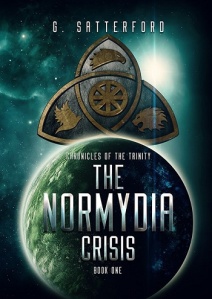
While I’ve been over here in the corner umming and ahhing to myself over the challenge of attempting to become a paid, published author, a friend of mine has thrown caution to the wind and dived in headfirst. Gregory Satterford – fellow re-enactor; ex pro wrestler; fitness instructor – can now add ‘published science fiction author’ to his list of extravagant professions.
I suspect the thought of self-publishing will have crossed the minds of most writers. Who wouldn’t be tempted by the prospect of publishing on your own terms, without the hassle of submitting to multiple agents and publishers; without the gradual erosion of self-esteem as you deal with an inevitable influx of rejections; without the pressure of a publishing house bearing down on you with contracts and deadlines and obligations to fill.
On the flip side, it sounds like all of the above is replaced by the hassle of having to produce your book by yourself. All the proofreading, editing, and formatting is down to you, unless you want to pay extra to outsource those services. Then you’ve got to handle the distribution and marketing of your book, and that’s no task for the faint of heart. I’ve always been curious as to whether the effort required, and the money, to an extent, is worth the end result. What is involved in the process? What do you get for your money? I took the opportunity to grill my newly appointed author friend on his experiences starting out in the indie industry. Here’s what we talked about:
1. Obvious question first. Why did you choose to self-publish?
G. Satterford, author of The Normydia Crisis
“No-one else would have me? Seriously though, I made some forays into various publishers but on discovering the benefits of a publisher were actually not great I decided I would try to go for myself. As far as I can tell I would be paying all the same charges, cover art, advertising, etc. and losing much of my income for the strength of a publisher’s name. In the balance I would rather be able to work my own time-frames and work with my own dreams without interference. In time I may come to regret this, but with the growth of self-publishing I’m hoping to the contrary.”
2. How did you decide which publishing tools to use?
“I chose Amazon Kindle Unlimited because I have been a satisfied user of Amazon Kindle for many years now and they have the most convenient way of publishing work to the widest audience, as far as I can see. Kindle publishing seems tailor made for the independent publisher as the editing is fairly simple for the computer savvy and there would be fewer charges to worry about, such as printing and delivery, so I decided to go the electronic route for my first foray into publishing. I had not planned to publish in paperback until I had released another few books and was more established and confident, but due to demand I located CreateSpace through Amazon as well and found them a helpful company for reformatting and cover work. It turned out paperback was also well catered for, the most difficult part being the page editing to fit their requirements and create a professional appearance.”
3. What can you tell us about your experience with Amazon Kindle Unlimited and CreateSpace?
“Publishing through Kindle has been remarkably stress free, they have an excellent review system to check the formatting and help topics covering most subjects with a responsive help team. It is excellent that I can adjust the manuscript at any time and it will filter through to the purchased copies and the deadline feature for publication really helped to motivate. Kindle Unlimited is a good feature for new authors as people do not need to buy the book and it is interesting to see how it is developing, but they do not allow usage of other ebook vendors such as Google. This is restrictive so people will need to decide which way they would rather go, but I felt I would experiment with them for a while as it seems a good option for a new name like myself in publishing.
Createspace is fairly easy to sign on to and use, and the staff are very helpful. The only issues I found were trying to adjust and match the formats from Word with their book layouts, requiring a few proofs before we got it right, but that is all just part of the learning experience. Cover art proved very different when printed in particular, with gloss and matte options and other similar things making it a bit more complicated. Once you get the hang of their system it’s a lot simpler, it just takes some patience.”
4. What costs were involved in the process?
“Aside from the writing software I also needed to spend money on my cover art (being an appalling artist myself), editing, proof-reading, and advertising mainly. The art was done through 99designs where I auctioned the image idea and discovered many fascinating interpretations from various artists, then selected the one I liked best. Then there are potential costs for editors and proof-readers but I was able to minimise these by enlisting the help of friends and family. I would recommend a professional if you have the funding available as no matter how devoted family and friends may be some errors will get through, whereas someone under contract has his payment hanging on his accuracy, which is an excellent motivator for scrutiny. Advertising is proving the easiest cost to run away with as there are so many methods of varying effectiveness around the web. The actual publishing is free to use through Amazon and CreateSpace: the companies take a percentage of your book sales only.”
5. Part of the appeal of traditional publishing is that the publisher handles a lot of the legwork, especially where it comes to distributing and marketing a book. Self-published authors seem to have to take on a lot of extra labour – how have you dealt with that workload?
“I’ve actually found publishers I checked do not help with advertising beyond a page on the website and some advice on book signings, etc. Most indie authors I’ve spoken to have the same legwork as traditional ones. I’d say the hardest to work on was editing my own work and making it good for publishing, requiring a strict timetable to hit my deadline.”
6. How do you support yourself while writing? I’m guessing the new book might not be drawing in $$$ straight away.
“At the moment I’ve only been published for a few months so I’m still putting the sales aside to pay fees. I am continuing to work as a fitness instructor for the majority of my income while writing when I can.”
7. Do you think the cost and overall effort has been worth it?
“Yes. No matter what the result I’ve enjoyed writing my work tremendously; creating a large universe of lore beyond anything I expected to do when I started. I’ve got a 5 star review that pleases me more than I can explain and I hope that it is received favourably in the future so I can continue to explore the galaxy with my readers.”
8. And finally, in 50 words, tell us what your book is about~
“It is based in a dark future where genetic engineering has created three castes of humankind: pure Lowborn, the enhanced Highborn, and the mysterious Bloodborn. Book One introduces this galaxy and prepares the four characters for a rebellion in a vassal world amid an alien invasion and great social upheaval.”
If you want to find out more about Greg’s work you can follow him on social media, or check his website for some free short stories related to the Normydia series.
P.S. Are you an author in either traditional or indie publishing? I’d be interested in hearing how your legwork compares to Greg’s – is it true that big publishers don’t necessarily offer much support? How crucial is that big name to drive sales?
Moved into new house: Check.
Switched utility suppliers: Check.
Found new internet provider: Check.
Castrated unhelpful TalkTalk employees: Check.
Finally uploaded Episode 13 of the Hansard Series: Freakin’ CHECK!
I know it’s taken a long time, but it’s finally here. That was a ridiculous cliffhanger to be left on, wasn’t it? Everyone’s stranded in the Nether, Ang’s dying, Hansard and Jo are in mortal peril, something BIG is about to happen . . . sorry for the wait. The upside is that because Episode 13 was sitting on my laptop for so long, I’ve been tinkering with it for ages and it just kept growing – so it’s a good 2000 words longer than a normal episode. And it’s a fairly tasty installment: we get the first real insight to part of Hansard’s past; we finally find out what happened to Ang; and could it be that Baines and Grayle are involved somehow?
Furthermore, to help make up for the month-long silence, I’ve got some extra doo-dads to show you on the blog, including some bonus short stories and an interview with an author-friend of mine.
For anyone who may have been expecting Episode 13 of the Jack Hansard Series to go up today, I’ve got bad news for you. The next update is going to be delayed until I have access to internet at my new house. Happily, the house move itself was successful (yay!). Sadly, the internet switch was lost to the bowels of some bureaucratic hell within the offices of TalkTalk (boo!). May those responsible be accosted by the fluffiest of nightmares.
This frustrated update coming to you from my very nice friends who are allowing me an evening to do such boring things as pay my bills, check my emails, and most importantly, change my internet provider. Should be set up by the end of the month. See y’all again soon!
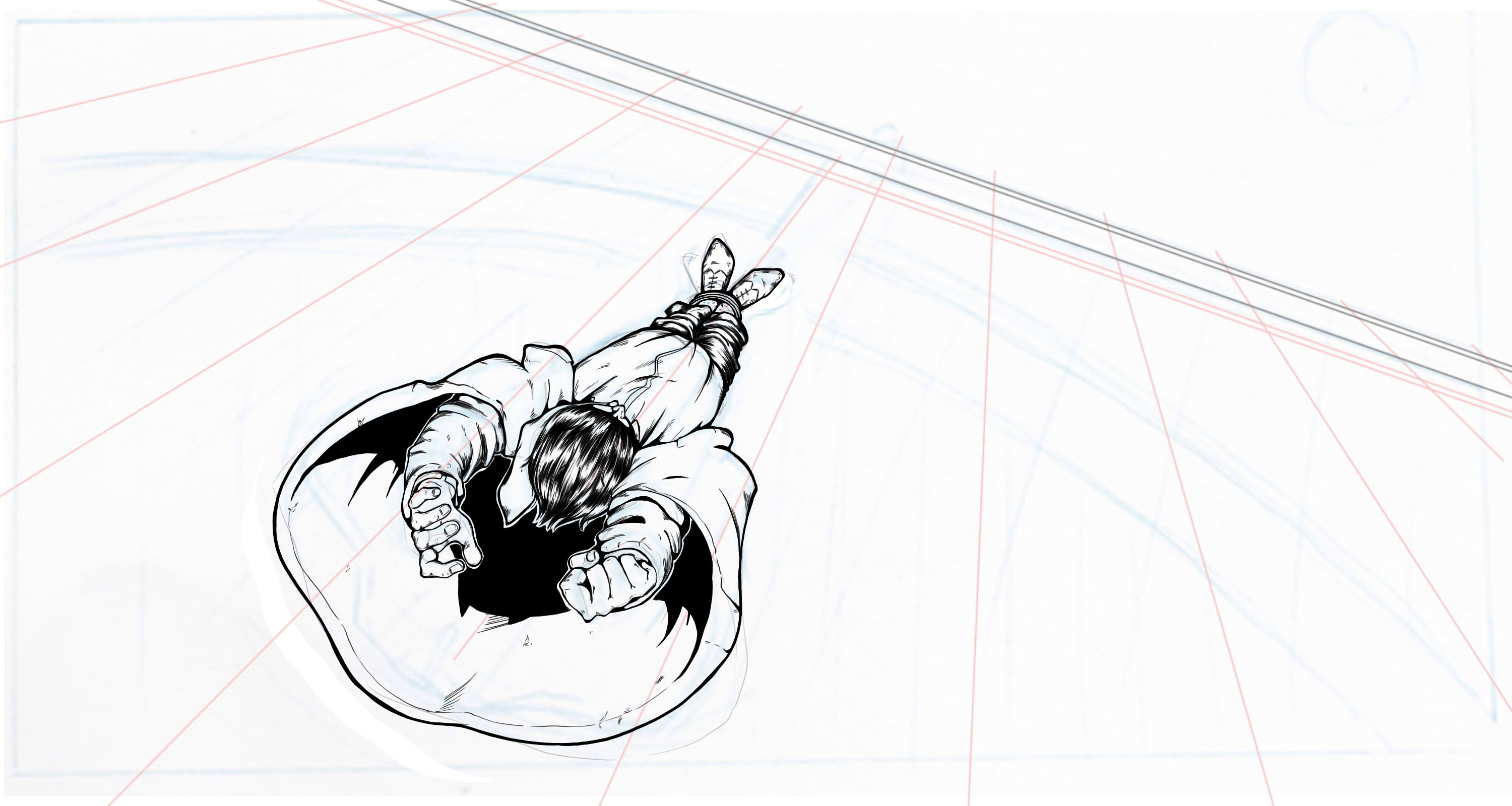
P.S. To make up for the lack of Hansard, here’s a sneak-peak from artist Dom Lane. This is the WIP of the title image fro Epsiode 1. (I’ve seen the finished image. It looks EPIC.)
The red fuel light blinked at me accusingly. I grimaced.
“I suppose it was a bit fast. Sorry about that. I’ll take the ticket and be on my way, shall I?”
I tried to surreptitiously knock the pile of other unpaid vehicular fines off the passenger seat.
“I’ll need to see the license, sir,” the police officer said suspiciously. Her eyes surveyed me and my scruffy attire, then moved to the tattered maps spread across the dashboard and the half-finished bag of yesterday’s chips nestled in the open glove box.
I hoped she wasn’t going to try and search the car. I really didn’t want her to find the body in the boot.
It’s been a while since we last saw Hansard at the Black Market gathering in Hull (where he was picking a fight with fellow traders and desperately trying to find more information on the girl with the quiet eyes) and it seems that he’s had plenty of time to find more trouble since then. In this week’s episode he’s held up by a run-in with the law – and this is bad news for the unfortunate police officer who tries to arrest Hansard. They probably don’t train recruits on how to deal with being pulled into another dimension at the academy.
As always, feedback and constructive criticism welcome. I had a lot of fun writing this one, so I hope you have fun reading it 🙂
Next series update will be Wednesday 22nd of July.
The world is full of thunder, though there isn’t a rain cloud in sight. You see the cannons before you hear them: a silent plume of fire and smoke, followed by the booming shock wave that sweeps across the battlefield, travels up my legs and rattles the shako on my head.
Behind us, our own guns return fire.
Boom.
One of the Korporals has delighted in telling me, over and over, “Y’don’t see a battle. Y’hear it.” A sentiment which I understand to have originated from an officer of the 95th. And now I understand what it means. The white smoke drifts across the field like a thick fog. It passes in font of our battalion and for solid minutes we cannot see more than six feet ahead, let alone the French soldiers lined up on their ridge.
“Here comes Nosey!” shouts our Feldwebel. We turn smartly and stand to attention as Wellington rides by. Rumour has it that Bony was sighted holding afternoon tea on the other side of the field. Will we catch a glimpse of him before the day is out? He’s out there somewhere, hiding in those lines of French. Over two thousand of them, all lined up on their ridge, and us on ours, and all the while our guns are firing.
When the smoke thins there is no longer a line, but a column of French, at least ten ranks deep and advancing towards us in marching step.
Our boys ready their muskets and the order to fire is given. The sound is a crack through the air, and it cascades down the line in a rolling surge of smoke and flame. Another volley is called. Crack. Another, and another, and still the cannons boom behind us, and still the French advance.
The smoke thickens again – I am surprised to find it smells heavily of eggs. It clings to my throat, makes the very air feel heavy and grey. High above, fantastic smoke rings curl lazily against the sky, while on the ground the clouds crawl sluggishly around us.
And out of the clouds come the French.
“Fix bayonets!” comes the desperate call.
The lines clash in a riot of colour and noise and metal. French blue against the black of the Brunswickers to the right, and against the reds and greens of the Highlanders holding firm on the left.
We hang back with the supply wagon, distanced from the fray but hardly out of it. I risk a glance to my right. The same scenes are being played out as the battlefield stretches on, blocks of red fending off blocks of blue, cavalry diving in and out of the melee. The farms of La Haye Sainte and Hougoumont are surrounded; my prayers go to the boys inside.
A shout and sudden chaos: a French horseman has broken through the line and advances towards us, alone. Is he insane?
I dive behind the cart – I am unarmed, but what French would care? Our bodyguard hastily draw their swords and surround us. The horseman isn’t mad after all; perhaps he’s just now realised he’s left his company behind. He turns tail and breaks back through to his own men.
The lines have separated now, the French retreat. Our volleys go into their backs. It’s time to advance.
I’m in position by one of the limbs of the cart, braced and ready. “Auf!” is the command I’m waiting for. We hoist up the cart and drag it forwards, ploughing through the waist-deep grass. It is like wading through prickly mud. Ahead, the army leaves a trampled void of flattened stalks where it passes. It will be easier through there.
At least, it is easier until we reach the bottom of our hill; now we start the climb up the next ridge.
“Halt!” shouts the Feldwebel. He is panting, and so are we. The black uniforms are hot and heavy, and the cloying smoke is still in my lungs. It’s nauseating. As I take a swig from my canteen, I spy the surgeon running towards us. His apron is bloody, and he holds an armful of empty canteens.
We can barely hear him over the roar of the guns, but his mouth frames the word: “Water.” We work as fast as we can, hauling the great jugs off the cart and refilling canteens as fast as possible. Any moment now we’ll be called to advance again, and we can’t afford to be left behind.
There is an almighty crack right beside us, and for just a second the world goes eerily silent save for the ringing tone in my left ear. As sound filters back I spy the culprit, a rifleman dealing with a misfire behind the lines. My muscles relax where they had tensed for flight.
As the surgeon withdraws, he is replaced by a lanky Brunswick Jäger. He doesn’t bother to salute, just opens his cartridge pouch and says with a grin, “Ammo please!” This is a job for the Quartermaster General – even with all that gold braid weighing him down, he’s a practical man to have on the field – the strongbox is unlocked, the black powder cartridges rapidly unloaded, and the Jäger sent on his way.
No sooner has he disappeared into the smoke another officer approaches. We have orders to resupply the Gordon Highlanders to our front and the 42nd to our left. Our relatively quiet corner of the battlefield is suddenly a squall of activity: we can’t pour water fast enough nor assign cartridges with enough speed. We hear that some of the men are completely out of ammunition. We can’t keep up!
And suddenly we are advancing again. With aching muscles we haul ourselves and our cargo up the slope, manoeuvring around bodies of French dead. It is chilling to think that I am walking across a graveyard. The sky overhead has turned an ugly grey.
Peering ahead, I can see a column of French backing away, huddled in on itself, harassed by cavalry and gradually being swallowed by the Highlanders. The Brunswickers advance on, over the ridge and to victory. The French are fleeing.
Our Brunswick motto rings in my ears: Nunquam Retrorsum. Sieg oder Tod.
Never Retreat. Victory or Death.
I look back, and see that we have walked a quarter of a mile from where we began. La Haye Saint lies in ruins; Hougoumont a burning wreck.
I cast my eye over the assembled dead. One of the bodies sits up, and takes a photograph.
The smoke is clearing, the booms and cracks have died away, save for the occasional puff of smoke as someone rids their gun of its last charge. We are approached by a group of weary French soldiers – Imperial Guard, I think – they wear ecstatic grins where terrified faces should be. We offer them some water: it is a long march back to camp, after all.
Bonaparte himself walks by us.
“They’ve left me behind!” he says, comically.
The night is drawing in by the time we leave the battlefield. I won’t reach my tent until midnight, and when I do I shall hit my pillow and sleep like the dead until dawn.
And then tomorrow night, we shall do this all over again.
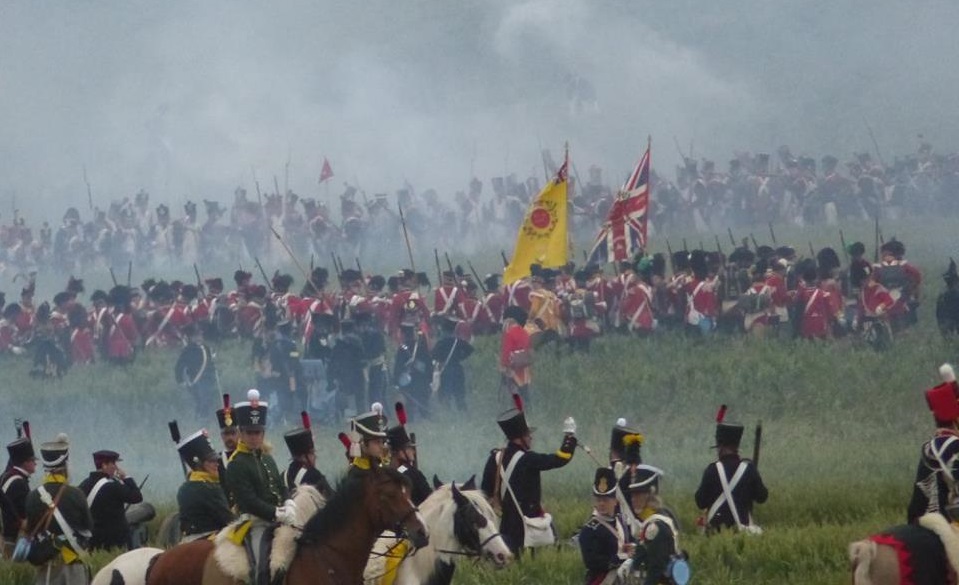
And that, folks, is how I spent my holiday in Belgium – the reason I postponed the next Hansard episode. If you missed the news, it was the 200th anniversary of the Battle of Waterloo, portrayed with around 5000 re-enactors – I’m telling you, it was huge. I didn’t even have to exaggerate most of what is written above. The only real embellishments are the burning of Hougoumont (which happened in real life, but not during this re-enactment) and the order that some of the stuff happens in. It was loud, it was at times terrifying, and it was also awesome in the truest sense of the word.
Impressive and intimidating volleys. I’m one of the small blobs of black next to the bright blue cart on the far right, just behind the line. Photo reproduced with kind permission of Moritz Brehmer.
The sheer sense of chaos is what I will treasure most. There were moments when my commanding officers were practically screaming at us to run into the middle of a square of Allied soldiers because French cavalry appeared to be flanking – because if there’s anything that a small, undefended unit dragging a cart don’t want to face, it’s any kind of cavalry. It was genuinely hard work, but it’s an experience I want to keep logged in my brain in as much detail as possible for future reference. As I was breathing in that strangely egg-flavoured black powder smoke, there was a big portion of my mind thinking, ‘I’ve got to remember how this feels so that if I ever want to write about a big battle with guns I know how to write it . . . ‘
In the thick of it. French advance on the Highlanders while we guard the supply cart just behind. Photo reproduced with kind permission of Jim Moore.
But although that’s the closest I will ever come to experiencing what a real battle might feel like, I am very aware of how vanilla our experiences were – we were spared the gore and the shrieks of pain and the wreckage of a landscape. Most people were wearing a great big grin, like they couldn’t believe they were really there. I couldn’t believe I was really there.
And I couldn’t believe how many people died here, two hundred years ago. I looked out at the massed ranks of both Allied and French soldiers spread out before me, and knocked sections of them down in my head. Boom. You’re dead. Boom. You’re dead.
And at one point I realised: there are only about 5000 of us here. The historic battle suffered over 40,000 dead. I looked at this field filled with people and saw them all littering the ground; every one of us would be dead men. I’m not a praying kind of gal, but I gave my own private homage to the fallen. And of course there was the laying of wreaths and singing of hymns and other little rituals done by each regiment. I’m sure every individual had some little ritual of their own.
I don’t know what those soldiers would have thought of us here in the future, play-acting at what was probably the worst event in their lives. Grim thoughts like that can spoil this hobby, if you let them. The important thing is to temper our fun with respect, and to temper the spectacle with compassion.
Nunquam Retrorsum.
Sieg oder Tod.
Brunswick shako hanging on the surgeon’s tent. Photo reproduced with the kind permission of Pauline Wilmotte.
Apology incoming. I’ve given in, and decided to postpone releasing Episode 10 until next Wednesday. You know what I was saying about life getting in the way? It continued to get in the way. It sounds like a feeble excuse to my ears – after all, there’s always time to write, right?
Definitely. I’ve been eking words out in spare moments at work. I’ve stayed up far too late on days that I shouldn’t in order to eke out some more. I found a few hundred words while squinting at my laptop during the long car journey home yesterday. I even managed about a hundred once I reached home, before the headache kicked in. I got up early this morning to make a last ditch effort on the thing – because better late than never, right? Then I read what I had written, and discovered that it was all a bit shit, and still wasn’t finished. Am I going to be able to correct that in the next two hours before I leave the house again? No.
I realised that over the past fortnight I’ve had very few nights in my own bed. I don’t think I’ve stayed in one place for much more than a day or two; the pile of washing up in the kitchen just keeps growing, and there’s something reminiscent of Hansard’s Odious Miasma living in the bin. I’ve got a couple of hours to deal with some of these things, but then I won’t be back home properly until Sunday night. Ugh. Some of the reasons for this constant movement have been unpleasant (a funeral on my partner’s side of the family, a friend moving away, etc) and some of the reasons have been exceedingly pleasant (such as a friend’s wedding, and a mutual belated birthday gift of a trip to the Harry Potter studios with my sisters – darn worth it, by the way). I’m stubborn as hell, and didn’t want to admit that I might have a teensy bit of trouble getting the latest episode finished on time. Because there’s always time to write, right?
Although I agree with this sentiment, I’ve often wondered how other people achieve it. Because when you say ‘there’s always time to write’ – are we talking about making time, or finding time? They’re two different things, and not equally possible. Ideally, you ‘make’ time by refusing other commitments – you say no to seeing your friends for a day, as an example. But it’s never as easy as that. Even though there’s this cliched image of a writer being in social isolation as a necessary consequence of their work, I’m not sure I believe it. I don’t think I’m an overly special case in that I live too far from friends and family to see them several times a week – there is no twice-weekly pub outing, or the like. But it does mean that social requests are not easily refused. For instance, I could have refused to go my mate’s leaving do, freeing up an entire, valuable evening for writing. But I don’t see him often as it is, and would rather be there to say ‘see ya, good luck, don’t fuck up’. Kinda what friends are for. I could have refused to see my sisters this week, which would have freed up an entire afternoon on Sunday and all of Wednesday. But they’ve paid money to have a week’s holiday near me, and frankly I’ve only seen them twice this year – we’re all skint, so visits are rare.
In my experience, most social commitments are like this. I don’t know if it’s a sign that I’ve become more of an adult, or if it’s just a symptom of moving out of the city (i.e. that place where my friends are) but I find social engagements involve a complex amount of give and take, and they are far more valuable to me now than they were a few years ago. It’s darn difficult to make time by dropping friends and family.
Then there’s finding time, which, if you’re like me, often involves stealing time-sheets from work so that you can write passages on the back of them during your shift. Or fighting the sun as it obscures your view of the laptop in the car. Or sacrificing sleep in exchange for a few more difficult words. This feels easier than making time, because you don’t have to explain it to anyone. You don’t have to let anyone down. Except, I suspect, yourself. The problem with finding time is that really the only person you’re stealing minutes from is yourself. Minutes you should be using to rest, eat, sleep. If you know that you’ve got a long week ahead, if you know you’re going to be hopping between cities and getting less than six hours sleep for several nights in a row, and then still getting up for work in the morning – it’s your own fault for trying to fit in even more work, and burning yourself out by the end of it. Should have made time instead, idiot.
These sound like excuses for why I haven’t met my self-allotted deadline. They’re not meant as excuses – just as observations. Lessons, hopefully. When trying to make or find time it often feels like you can’t win, because everybody else is demanding your time, too. How do you work around that? I’ve read that some people assign one specific day a week as their work day for writing. It’s treated like any other day at work. Friends, girlfriends, boyfriends, spouses, everyone else is told to stay clear, let the writer do their thing in peace. I love the idea, but I’m doubtful about how it works in practice. Regardless of whether you lock yourself away from the world or not, the world comes knocking just to tell you “The washing up needs doing and something might have died in the bin.”
Because even though you view your writing as one of the most important things in the world, few people share that view. I don’t yet think I’m at the point where I could tell a friend: “Sorry, I can’t come see you because writing is more important at the moment.” That sounds like a slap in the face. In my head, the response this gets is along the lines of: “What? Your stupid little short story thing, which isn’t exactly premier literature and nobody reads anyway – this is more important than a day with your friends? This silly, petty pastime is more important than your other hobbies?”
And inside, there’s this meek little voice that just wants to say: “…yes…”
Dang, it all comes down to self-confidence again, don’t it? Like rivers to the sea, follow your problems in writing and it seems they all lead that way. There’s a great big sea of self-trust out there. I’ll reach it, eventually. Ina little boat called Endeavour. Could you get any more twee?
Well, lookee that. I started with an apology and ended up with a piece that vaguely resembles something interesting. To recap: Episode 10 of the Jack Hansard series will be released on the 10th of June, in a suitably more entertaining and well-written state than it currently is.
I ran, crashing wildly through the crowd. Snarls and growls followed in my wake – what’s a few trampled toes and elbowed faces? – I was too intent on my goal to pay them any mind. I reached the spot where I’d seen her, and spun round in desperation.
“Where’d she go?” I shouted, frantically. I threw myself into a nearby cluster of people, certain she must be hiding in amongst them.
“Watch yourself, mate,” said one of the surly men as I broke through.
I grabbed him by the shoulders and practically screamed into his face: “The girl. Did you see her?” With a stunned expression, he dumbly shook his head.
In the latest episode of the Jack Hansard series the search for the quiet-eyed thief intensifies, and Ang receives the affections of an unlikely admirer. A bad decision in the heat of the moment might land them in a whole heap of trouble – but what’s new there?
What’s new here is that there’s new content in the works. The Folklore Snippets are fun to write and I intend to keep writing them, but perhaps to a less rigid structure, allowing me to branch out and experiment whenever the hell I feel like it. If I fancy writing a blog post on Tuesday, but an update isn’t due til Thursday – well, I need to get my head around the idea that are no rules here, because this is my space, so I can damn well put that post up on Tuesday with no explanation. Ditto if life gets in the way so that a supposedly expected blog post is a day late (it did get in the way this week, as it happens – Christ, sometimes it’s like people die on purpose – but the important thing is that I stuck to my promise and the Jack Hansard Episode 9 was on time. Yeah! But sod the blog). I wish I could stop feeling like I have to explain myself every time I decide to do something different – do I fear the judgement of an invisible (and so far silent) audience that much?
Sure, I guess I do. Doesn’t every writer? Wasn’t the whole point of putting my work online to get over that fear and face the judgement of others, silent or otherwise? Wasn’t the whole point, in fact, to build up that self-confidence so I don’t feel the need to ask politely if I can do the thing I want to do, so that I don’t feel like I have to tip-toe around this idea that I like to write things? Why am I embarrassed about that? I need to own that embarrassment, somehow.
I’m getting off-track. Not that there was much of a track to begin with for this post – and frankly I’m finding it quite refreshing. The odd ramble is good for the soul, no?
Anyway, besides all that, there’s something very exciting happening behind the scenes. So exciting, I’ve been bursting to shout about it for weeks, because I’m impatient and want everything to happen at once. An Inspired Mess has been joined by a frankly outstanding illustrator, and we’ve been working hard to bring the Jack Hansard series to life with some shiny pictures! And they are seriously shiny. I wish I could show you all of them, right now – but, like me, you’ll have to wait until they’re finished. Maybe we’ll do a big reveal, Hansard style.
Until then, expect some sneak-peeks of concept art over on the Facebook page, and a formal introduction to our new illustrator here on the blog.
I guess I should go and start working on Episode 10. See ya soon!
Last week’s Episode 8: Black Market featured a couple of interesting new beasties to choose from for this snippet. On the one hand you have Devin Tracey, the charming Irish siren; on the other you have the alluring female huldra. And as I suspect you are least likely to have heard of huldra, she will take the limelight today.
You don’t see much of her in Episode 8, which is a shame, because I think she’s a really characterful creature. She’s of Scandinavian origin, and might be likened to a forest nymph, or a type of troll. She typically looks like a beautiful woman from the front, but from the back you might see her cow tail. If you get to see her bare back, you might find that it is hollow and made of bark, like the dead trunk of a tree.
Now, whenever I do the research for my folklore snippets, I always have the same problem: digging through endless reams of similar but vague descriptions about the creature in question. Yes, unsourced internet article #178, that’s some very interesting information you have there, but it’s no use telling me that: ‘Some stories say…’; or even that: ‘One story from the South of Norway says…’ Which goddamn story, article #178?
What is it called? Who wrote it? Where can I find it?
Ahem.
I found them eventually. A lot of Norwegian folklore was collected by a pair of writers called Peter Christen Asbjørnsen and Jørgen Engebretsen Moe in the 19th century – they are the Scandinavian Brothers Grimm. Huldra apparently feature in a number of these stories, but the problem with Norwegian folktales is that they’re in, well, Norwegian. One great source for an English translation of their work is George Webbe Dasent’s translation of Popular Tales From the Norse – but I haven’t found a story about huldra in amongst these. So instead I’m using Clara Stroebe’s The Norwegian Fairy Book, which features many of the same stories. I’ve picked out two tales which show you some of huldra’s main characteristics:
The Troll-Wife tells the story of how a human man desired a beautiful huldra – she is described as a human-looking troll with a cow’s tail. But she loses her beauty the instant she is captured by this foolhardy man, and he is forced to marry her despite her ugliness. During their wedding ceremony, her tail drops off. At first her husband treats her badly, bitter over her bad looks. The huldra remains well-mannered and even compassionate toward her husband – until one day she shows off her full troll strength by bending metal horseshoes with her hands. Surprise, surprise, her husband is suddenly much kinder to her from that moment onwards.
The Player on the Jew’s Harp is a similar story about a man wedding a huldra maiden, but in this case there is no mention of a cow tail, and she remains beautiful throughout. She is described as being one of the underground folk, known variously as the huldrefolk and ‘the hidden people’. In the story it seems these people cannot be easily seen by human eyes, and they can bewitch other creatures to be hidden as well. The man attracts the huldra’s attention with his skillful playing of the Jew’s Harp (huldra seem partial to beautiful music) and unwittingly captures her by flinging the harp at her head, accidentally drawing blood. Now, in this story a big thing is made of the fact that the huldra is not a Christian. In fact, once they are married, the husband begins to bully her because of this. She ends up displaying her strength in the same way as the Troll-Wife huldra, by bending red-hot horseshoes with her hands. For a while after that the husband is good to her and they prosper. Then his mind darkens, and he goes back to his old ways. One day he beats her, draws blood once more, and she vanishes forever. She doesn’t die; she simply becomes hidden again and spends the rest of her life protecting her husband from her own friends and family, who understandably want to make him pay for his wrongdoings. It’s a very sad tale, made bittersweet by the enduring love of the huldra for her husband. He dies an empty man, full of regret for what he has done.
In both these tales the huldra comes off as a very sympathetic character, but in other tellings she is painted with more cunning motives, actively hoping to trick a human into marrying her so that she may lose her tail and become human herself. If I come across an online English source for these stories, I’ll let you know.
In more modern news, there’s a Norwegian movie about a huldra that I am dying to see: Thale. Fantasy, horror, and my new favourite folkloric creature? Hell yes. Have you seen it? Is it worth spending a whole £8 on? 😛
Episode 4: Coal and Pies is now live. This week concludes the story of Hansard’s dealings with the reclusive Coblynau, featuring pies, coal, and a brush with death.
The newest creature Hansard encounters in this escapade is the mysterious Bluecap. Related to the Welsh Coblynau and Cornish Knockers, this creature also lives in mines. Unlike Knockers, it doesn’t have a humanoid appearance. The Bluecap is said to appear as a blue flame and might be a kind of ghost or fairy creature. Like the Knockers, Bluecaps seem to have honest, hard-working motives: some miners have claimed to see them transporting full tubs of coal about the mine – the job of a ‘putter’, in mining terms.
The Bluecap would also lead miners to rich deposits, so long as they were treated respectfully. It’s a recurring theme that insulting folkloric creatures will only result in mischief. But some of these creatures are more mischievous than others, like the mine-dwelling Cutty Soames. I’ve seen Cutty Soames referred to as an ‘elf’, so I think of him as a cousin to the Knockers. He is named for his most unhelpful habit, the cutting of the ropes (‘soames’) that connected the putter to the coal-tub. When I learned this I couldn’t help but name the treacherous character in Episode 4 after him, it fit so nicely.
Both the Bluecap and Cutty Soames are described in an article in the Colliery Guardian of May 13th, 1863. The writer describes them both as a type of goblin or elf, and of Cutty Soames says:
‘He rejoiced in the name of “Cutty Soams,” and appears to have amused himself by severing the rope-traces or soams, by which an assistant-putter, honoured by the title of “the fool “, is yoked to the tub. The strands of hemp which were left all sound in the board at “kenner-time,” were found next morning severed in twain. “Cutty Soams” has been at work, could the fool and his driver say, dolefully knotting the cord.’
About the Bluecap, we are told that it expects to be paid the same wages as a putter, once a fortnight. Allegedly the Bluecap will only take its due, no more nor less. Wages were left in a specific corner of the mine, and would disappear overnight. (Methinks a human miner came away a little richer from that transaction.)
It’s easy to see how a mine can be a rich environment for the evolution of mythic creatures. With no end of strange sounds, knocking, dripping, whistling, and a constant threat of danger – think sudden cave-ins and fire-damp explosions – it’s a smorgasbord of possibilities for ghosts and goblins to take the credit. I know if I was a miner, alone in the dark with only a mysterious knocking for company, I’d like to think that I simply had a non-human companion hard at work on just the other side of my seam. And if I escaped a collapse with just seconds to spare, I know I’d be putting out food or money to help keep the critters on my side. Danger breeds superstition, and we all feel safer with the thought that something might be looking out for us in those situations.
An addendum: Last time I ended with a section on Welsh words used by the Coblynau. I want to take a moment to talk about just one more: gwas.
When working out how the Coblyn Ang speaks, I wanted to give her a nickname she could call Hansard, something that fit snugly anywhere in a sentence. Ideally, something akin to the word ‘mate’ in English. An initial Google of the word told me that gwas might be a slang term for mate or boyo, and it sounded perfect. However, a more direct translation tells us that gwas actually means ‘servant’ or ‘lad’ in a similar sense.
After some thought I decided this fit nicely. Assuming that Coblynau slang might be different from modern Welsh anyway, a derogatory nickname with a servile meaning at its roots was perfectly suitable. Plus, it sounded snappy.
Am I over-thinking this? You betcha! But detail makes me happy.
Thanks for reading, folks. Here’s the further reading list if it floats your boat:



 Georgina Jeffery