As we stand on the edge of another new year, it seems like a good time to look back on what I’ve managed to achieve in 2019. I’ve always found it helpful when other writers share their submission stats, so I’d like to do the same here.
2019 is the first year I’ve gone on the attack with submissions, so to speak. It’s fair to say I was lackadaisical about it up til last January: I wrote the odd short story and pined for somewhere it could live. No more.
No more staring wistfully at submission guidelines like a far-off lover. No more dreaming of having a story perfect enough to present as a token of my affection. Get it written. Get it sent. Then get it sent again. And again. And again.
So how many times did I get a story sent in 2019?
Number of Submissions: 17
Submissions Declined: 13
Submissions Accepted: 3
(No response received: 1)
Only 17? Dang, it felt like a lot more.
This comprised 11 shorts sent to various literary magazines, websites, and anthology open calls. Some were written specifically for the submission call; many were not; many were tweaked. They ranged from weird horror to dystopian sci fi and contemporary fantasy. In some cases I waited mere days to receive a rejection; in at least one it took six months. 3 out of 17 stories accepted doesn’t sound bad, though.
Oh, wait. Let’s look closer.
2 of those were stories accepted by Storymart, a little start-up that never actually got its feet off the ground. (Here’s the post I wrote about it back when I was deciding whether or not to submit to them.) Storymart’s creator ‘pressed pause’ on the project in July 2019 due to what sounds like a very stressful personal situation.
I hope that things improve for them, and that eventually they’ll be able to return to Storymart in the future. I remain incredibly grateful that they thought my work was good enough to become part of their catalogue, and also that for the story they rejected they provided some very helpful feedback on it – practically gold dust!
The other Accepted Story I only heard about a couple of weeks before Christmas. It’s early days yet so I can’t share details, but all being well, I’ll have my first short story ‘officially’ published in an anthology next year.
I’m so excited! I get a paycheck from it and everything.
(I know, I know, I shouldn’t still measure my worth as a writer by whether or not I’m being paid… but it feels good to say it, damn it!)
So I’m ending the year feeling pretty good. 17 submissions isn’t as many as I’d like, but it’s been a busy year. I was pregnant for half of it, and the other half I’ve been dealing with the result. And whatever the number, any progress is good progress. That said…
Goal for 2020: Beat that number.
I know what I’m doing now, and pressing that ‘Send’ button is no longer such a monumental task. If you’ve been submitting this year, I hope things have improved for you too. And if not, we’ve all got next year to work on it.
Folks, fabulous news. Nearly four weeks ago now, my daughter Evie came into the world. Here she is with a beautiful smushy grumpy face…
I’ll tell you what, giving birth was a hell of an experience. A lot did not go to plan, and I dealt with some circumstances and emotions I was not prepared for. But we both came through it happy and healthy, and I’m thoroughly in love with the tiny monkey-potato-human it all resulted in. To repeat a sentiment I’ve heard from many other parents: I still can’t quite believe she’s real – how on earth did I manage to produce that little creature? Witchcraft.
Husband has been my pillar throughout everything. We’ve spent the last month slowly letting the reality sink in and learning how to work as a family. Amid all the new routines, this is the first time I’ve managed to sit at the computer long enough to properly string some words together. [Edit: Ironically it was about this point in writing that I had to break to help Husband deal with an epic poo-nami situation.]
Now we’re settling into something resembling a rhythm, I’m feeling optimistic about gradually getting back to work. ‘Gradually’ is important – this is not the time to stack on the pressure, but I’m looking forward to getting back into my groove.
I imagine at some point I’ll do a follow up to my previous post, 5 Struggles of a Pregnant Writer, with ‘5 Struggles of a New-Mum Writer’… But first I actually have to get writing again.
Excuse me as I make a start on that, while she’s still sleeping!
So I should probably share the news that has been dominating my life for the last eight and a half months: I’m pregnant, folks. Yep, pretty soon my husband and I will be welcoming a wrinkly little potato-faced creature into the world – god help her.
With the impending arrival less than two weeks away, I started thinking about my experiences of pregnancy, and in particular the effect it’s had on my writing time. Perhaps predictably, my productivity has plummeted: for some reasons I was expecting, and some that came as a surprise. I thought I’d share them for all the other writer-mum’s-to-be out there… congratulations and commiserations to you, by the way!
So here are my top five gripes about trying to write while pregnant:
1. When you miss your coffee.
It’s a ritual for many writers, and I’m no exception – I enjoy my pre-work sesh coffee. I’ve never chain-drunk the stuff like some people I know, but I do now have to think more carefully about whether and when I drink one.
You may already know: your recommended max caffeine intake during pregnancy is 200mg a day, and one cup of (instant) coffee is around 100mg. The eye-opener for me was learning about all the other things I eat and drink that also contain caffeine: Coca Cola I already knew about, but chocolate came as a surprise. Don’t forget tea, if you prefer the more traditionally British of hot beverages.
This means if I have one coffee first thing in the morning, I can’t have one when I sit down to write in the afternoon. If I happen to drink a pint of coke (it’s an occasional treat for me) and gorge on a bit of chocolate, then it’s also probably best to avoid that coffee altogether.
Now, I don’t need coffee to write, but it’s a comforting habit that helps get me in the mindset for it. Especially after a long day at work, a cup of coffee when I get home is a good way of easing my brain back into the idea of doing more work, i.e. writing. Those after-work writing sessions became hella less frequent when I realised my one rationed cup of coffee was more essential to getting me through my regular workday instead.
That wasn’t the only reason productivity took a dive though, as per the next gripe…
2. When you’re too tired to write… all the time.
‘You’ll be a lot more tired when the baby’s here!!’
Thanks. Great advice.
People like to tell you to ‘enjoy your rest’ before the baby comes, but the reality is that pregnancy isn’t all that restful.
I wasn’t prepared for how dramatically the hormones kicked my energy levels, especially early on. It sapped my mood as well as my general wellbeing. One of my colleagues later told me they were worried I was hiding a serious illness, I’d been acting so off.
My morning sickness also hit me quite reliably in the evenings. Trying to write after work was suddenly a complete bust, regardless as to whether I could factor in a cup of coffee or not.
Now that I’m in the third trimester, my lack of energy is down to a lack of sleep. This belly is uncomfortable, y’all. But not just that: the symptom I’ve hated most, and which they don’t tell you about, is sodding acid reflux. Because your stomach is being squished and the muscles are somewhat relaxed, that acid burn is a relatively common feeling, especially at night. I take Gaviscon before I go to bed every evening, and with annoying regularity will still wake up two or three hours later with that same sickly acid in my throat. (Don’t try to give me home remedies, by the way. I’ve tried them all.)
To top it off, for some reason completely unknown to me, I’ve gone from being a person who could happily (nay, ideally) sleep in until midday, to a bloody morning person. Five AM is no longer an alien time to me.
Case in point: as I write, it is presently 5:20 AM. I’ve been awake since around 3:30 AM (woken up by acid, surprise surprise!), because my mind couldn’t stop alternating between drafting this post, and imagining worst-case labour scenarios. Hurray!
3. When your belly gets in the way.
I often sit and write on the couch, with my laptop across my knees. (I know, I know, it’s awful for my posture.) It’s comfortable, and situated in the nicest room of the house. I wish I had a home office set-up, but I lack the space and money. I use my dining table occasionally, but the back room can be a bit cold and dreary to spend long periods in.
So the day my laptop could no longer fit on my lap, I felt really pregnant. That belly has no give in it, whatsoever. So now it’s a delicate balancing act, where if I forget to keep my hands on the keyboard it just might capsize backwards onto the floor.
On the flip-side, I am now saving up for some kind of space-saving desk… Maybe one that fixes to the wall or something.
4. When you’re in the middle of a paragraph and then… you have to pee.
Needing the toilet more is par for the course in pregnancy. But it isn’t half annoying when it interrupts a great flow of character dialogue. Or, quite often, it happens very soon after I’ve settled into my writing groove: I’m comfy, laptop’s sort of balanced, I’ve got some cake, I’ve even managed to factor in the elusive coffee… then bam. Time to get straight back up for the loo.
Another classic is the internal punching-bag effect. ‘Lightning crotch’ is, I discovered, a widely-recognised term for this pregnancy symptom. It’s pretty difficult to concentrate when mid-sentence you might get a sudden twang right in the pelvis because Darling Angel has just decided to headbutt a couple of nerves or kick some of your organs around. Thanks, lovie.
5. When you have even less time to work with.
It’s already difficult to find a balance between your day job, home life and writing, and it’s a struggle I know virtually every writer (unless you’re one of the lucky ones) has to deal with. With a baby on the way, suddenly there are even more jobs that eat into writing time – buying all the baby crap, painting the nursery, figuring out and freaking out about the birth plan…
And if you’re not actively doing something related to baby, you’re thinking about it instead. Do we have enough baby wipes? How the hell do reusable nappies work? What, exactly, is the difference between a pram and a travel system and why does the latter sound like it should come with blueprints?
We have 1,316 baby wipes. We counted.
I’m also very aware that once the darling potato’s here, I’ll have even less time to spend on writing. But there’s got to be a way to make it work. There are tons of successful writer-mums out there: my question to you is… how do you do it?
Feel free to share your own #pregnantwriter struggles in the comments – and any tips you have for overcoming them! New-Mum-Writers out there – do you have any advice for those of us expecting? What are the new challenges you face trying to write while looking after a newborn? Am I being too optimistic to think I’ll have any time spare to keep up with writing? ^_^;
And if you’re in the same boat as I am: remember to take care of yourself, and best of luck to you and your potato!
The door slammed open in the force of the storm. The fisherman shrank away from his new bride, his retreat blocked by the invading tempest. She sat, demure, fragile; big seal eyes staring out from under long lashes.
‘I didn’t know,’ he moaned. ‘God help me.’
He watched the fur coat slough off her body like shedded skin, revealing naked flesh beneath. She held out a plaintive hand and barked, a seal’s bark.
He trembled, caught like a fish in a net. Her kiss was colder than the sea. It turned his blood to salt on his tongue.
This is another short I wrote for the 2018 Southam Flash Fiction Competition, which required stories to be under 100 words and to contain the prase ‘the door slammed’ somewhere in the work. I set myself an informal ‘folklore’ theme to tie my stories together. They were a lot of fun to write.
A friend told me that she laughed out loud at the selkie’s ‘bark’ in this piece though. Not quite the effect I was going for…
Lately I’ve been pursuing publication for some of my short stories, and I feel I’m settling into a good rhythm of submissions and rejections. My current goal, at its barest bones, is to be paid professionally for a piece of my work. A lofty one, I know. Anyone familiar with writing submissions knows just how low the acceptance rate is (I rather like this author’s breakdown of their submission stats, for context) and I know I’ll be waiting a long time for that elusive payout.
However, I came across an intriguing opportunity for short story writers recently. It’s called Storymart.
Storymart is a reader subscription service aimed at lovers of short stories. The creators envision a Netflix-like model, where the reader’s monthly subscription gives them unlimited access to the site’s story content which is provided by writers all over the world. And the writers, rather importantly, get paid.
However, the platform is very new. In fact, it’s not yet open to reader subscriptions as they are still in the process of gathering content from writers. This makes sense – why ask readers to pay for content that doesn’t exist yet?
I’ve been mulling over the concept for a while now, and to help me figure out whether I want to jump onto this infant bandwagon I decided to lay out my thoughts in a simple Pros and Cons list…
Pro 1: Storymart offers curated content to readers.
The platform practices a submissions process which promises to narrow stories down to those which are of a high enough quality – I’ll give you their own definition of what that means:
Welcome words for writers tired of the bellowing halls of Wattpad-esque establishments, where readers and writers alike are drowning in angsty vampire/werewolf/shapeshifter romances, invariably set in a highschool and demonstrating varying grasps of the english language.
The website seems to promise short stories worthy of appearing in established literary publications like The New Yorker, and so they are actively encouraging writers to only send their best.
Con 1: Storymart does not edit any of the content.
This might be a Pro if you hate other people fiddling with your words. In any case, it’s worth noting that submissions are expected to be polished upon entry, and you shouldn’t expect any hand-holding from Storymart in that respect.
How harsh their submissions standards really are is something that remains to be seen – we probably won’t truly know until the site launches for readers. Obviously there’s also chance those submission standards might lower over time. Will they stick to their principles further down the line?
If you’re a writer who has submitted to Storymart, what’s your view on this? Did they accept everything you sent them; did they give feedback on rejections?
Pro 2: They accept previously published stories.
If you’re in the business of trying to submit to professional markets, then hopefully you understand why this excites me. The majority of submissions guidelines invariably prohibit writers from submitting previously published work, whether it was in print, online, another magazine, a competition, or on a personal blog. This is a barrier I find intensely frustrating: it seems as though once I put a story out there, anywhere, then that’s kind of it for the life of that work. This is what’s putting me off submitting to the huge number of magazines which offer no payment to authors – I’d love the chance to be seen by your readership, but if I do then I effectively give up the prospect of being paid professionally for that story.
(Side-note: I know ‘re-prints’ of published work are sometimes presented as a submission option at a vastly reduced pay rate – and I’d be interested to know how many writers have any success submitting under this category.)
Storymart offers a chance to put some of those one-offs back in front of paying readers. Say you have a competition entry that didn’t win, but was good enough to place on the shortlist and got published online. This might be a way to give new life to an already-proven story.
Similarly, once you’ve placed a story on Storymart, there are no restrictions on where/when you can publish again. A lot of publications will, for example, require that you don’t re-publish your story for a specific period (typically 3-6 months) after it has appeared on their own platform. This means you can publish a story on Storymart and then continue to submit it anywhere else you choose. Of course, this does immediately throw up the very obvious…
Con 2: Publishing on Storymart counts as publishing.
If you put a story on Storymart, it’ll run into the exact barrier I was bemoaning above. Other publications may reject it out of hand for already being published.
However, the site is still in Beta stage for the moment. So I suppose during this window where it isn’t open to readers, you still have the option of removing your work from Storymart if it does find a home elsewhere.
Another counter-argument for this is…
Pro 3: Storymart is a paying market.
It runs (or will run) on a pay-per-read model.
Readers will pay a monthly subscription of $4.99 to have unlimited access to as many short stories as they want to read. Every time a story is read, the author is paid $0.10 USD. Payments will apparently be made monthly, via Paypal.
Con 3: The author is only paid $0.10 per read.
That means a hundred people could read your story over a period of months… and you’d only earn $10 for it.
But wait, let’s compare this to other industry prices…
Based on various bits of advice and my current experience hunting suitable markets, my perception of a ‘professional’ short story rate is around $0.06 per word. However, realistically there are also a very large number of publications offering much less (eg. some that offer around $0.02 per word; some that only offer a flat fee in the $20-50 range per story) and of course an abundance of completely unpaid opportunities that nevertheless offer exposure to their already-established audience.
Let’s go on the lower end and consider a 5000 word story which is paid $0.02 per word = a flat fee of $100 for that story. With Storymart’s model, you would need 1000 people to read your story to earn $100 from it.
I suppose the question is… are you confident your story will get at least 1000 reads?
This is where it gets interesting. Instead of receiving a one-off payment, there’s the potential to accumulate money over time… a very LONG time. Remember, if you only get ten reads a month, you’d need to wait 8-9 years to earn that $100.
At the moment we have pretty much no data to look at to determine what a realistic number of reads per month could be at Storymart. Could be in the hundreds – a hundred reads per month would take less than a year to earn the $100. Or it could be in the tens, and the payoff becomes minimal.
At least the principle is simple: the more readers you have, the more you earn. This will then probably be down to the individual author to market the shit out of their work to gain those consistent reads. And in order to get those reads you need…
Pro 4: A captive audience.
This, theoretically, is the big draw for writers at Storymart. Readers subscribe because they want to read short stories. They are, in theory, readers as opposed to other writers – which is a flaw I think is endemic of many fiction platforms (Wattpad, I’m looking at you).
I hold the apparently unpopular belief in wider publishing that short stories are an extremely under-rated and oft-forgotten (despite being popular) genre of fiction. I can’t fault the idea of pushing new ways to make short stories more accessible, and a platform dedicated to them sounds somewhat ideal.
Con 4: Currently, a small audience.
Here’s something that only time will illuminate further. At present, Storymart is still in Beta stage. That means it is actively seeking story submissions from writers, but is not yet taking subscriptions from readers. As I said, I’m a big believer that short stories are a vastly underestimated market, and there definitely is a passionate audience out there for them. But, will that audience choose to pay a monthly subscription, when there’s so much short fiction available for free elsewhere?
One response, I suppose, is that readers do already pay for subscriptions – to all those short story magazines I’ve been submitting to. That’s what the professional paying market for short story writers is.
Pro 5: The chance to grow alongside a growing platform.
Wouldn’t it be great to discover the next big thing while it’s still shiny and new and has opportunities ripe for the taking? Before the big boys muscle in and the playground gets swamped by thousands of other voices all peddling their own fantastical narratives?
At this early stage, while the audience might be small, the pool of writers is as well. Would that, potentially, make it easier to be discovered? To snap up the interest of new readers as the platform grows? Getting in early could make all the difference to growing a presence and a following, and if Storymart grows and grows and grows… well, it’s an exciting thought. But, therein lies the risk.
Con 5: The whole thing could flop.
Storymart isn’t quite on its feet just yet. Readers could flock to it in their thousands… or they could give it a passing glance and shrug, and go back to their tried-and-tested tenders of online fiction instead. There’s no data to look into yet, so your guess is as good as mine as to whether or not Storymart will still be here in a couple of years’ time.
But, even if it isn’t… what have I got to lose?
This is the thought I keep coming back to.
The main ‘Con’ which seems to bother me is that publishing a story with Storymart might restrict any future opportunities for that piece of work. But if that story isn’t being accepted anywhere else anyway… and let’s face it, the odds are massively stacked against us in submissions, simply due to the sheer mumber of other stories we’re competing with… well then, what’s holding me back but myself?
I’m not convinced that Storymart won’t have the same problem as other publication routes further down the line. If they do grow successful they’ll probably find their own inboxes at breaking point eventually, despite their best intentions to give submissions the quickest turnaround possible. More reason to jump in early, perhaps?
I suspect I’m overly cautious when it comes to making these kinds of decisions. I’ve doubtless missed opportunities just for fear that it might not be The Right One.
Wouldn’t it be better to earn a few dollars from a story – and to know that it’s actually being read and enjoyed by people – than just letting it languish in the ‘Submissions’ folder on my laptop?
I think what I’m saying is that I’m going to jump in. Because, really, what have I got to lose?
What are your thoughts on the Storymart concept? Just another online magazine subscription, or the Netflix-inspired service they aspire to? Are there better alternatives already out there?
If you’ve submitted stories to Storymart, I’d love to hear from you! Why did you choose them? What’s your experience been like so far?
If you want to read more about Storymart, their FAQ section for writers is here.
Rain gushed over ancient tiles, overflowed from dilapidated gutters, and dripped off the end of a cold, stone nose. A church congregation filed in under the cross-eyed gaze of the gargoyle.
The people were drab, in both colour and spirit. The door slammed, locking them in with their sins. Guilt should not be tangible, but the gargoyle tasted it in the rain.
It tasted anticipation, too.
An organ gasped geriatrically to life.
One by one, lonely voices joined into a growing chorus. The music swelled, and took a stone heart soaring upwards to heaven.
It strikes me that it must be rather lonely to be a gargoyle.
I wrote this as an entry to the 2018 Southam Flash Fiction Competition, which required stories to be under 100 words and contain the phrase ‘the door slammed’ somewhere in the work. I had a lot of fun with the theme and will share some of my other entries here as well.
A little update here on The Jack Hansard Series. Thanks again for sticking with me – we’re making steady progress! I know it’s proving to be a long wait, but I promise the end result will be worth it. I know it’s a bit dull to just hear ‘I’m editing’ over and over again, so I thought I’d give you all a little insight into what I’ve been working on, and exactly what ‘editing’ the series means in practice.
For a start it involves…
Restructuring
The original version of the series (still available to read for free on An Inspired Mess and on Wattpad) is written over 20 episodes. The final version will be just 15.
Wait! Don’t worry – nothing’s been cut, just condensed. The original episodes were written and published on a fortnightly basis, and realistically I could only churn out up to 5000 words in that time. This meant that several stories got split over separate episodes, and the episode lengths weren’t consistent. So you’d finish reading a satisfying 5000 word episode, to then stop short at the end of a 3000 word ep like: ‘Where’s the rest of it?’
So I’ve been working on evening out those word counts, and putting full stories into one episode wherever possible. For example, remember where Jack first meets Ang in Ironbridge? This was needlessly split into two episodes – there’s not even a proper cliff-hanger to lead from one to the other! So now they are joined together in one seamless story to be enjoyed without any interruption.
What this also means is I’m…
Adding New Content
Some of those stand-alone episodes are still too short, especially near the beginning of the series. You see, when I started out my episodes were only 2000-3000 words each, but as the series developed the characters found their voices and the plots became more rounded, demanding longer stories to see them through. You can see this in the explosive Phoenix finale, which took a whole five episodes to complete!
So I’ve been adding in extra details, and occasionally whole new scenes. Remember Episode 1, where Jack gets cornered by Scallet and makes a lucky and quick escape? The story no longer ends there. You now get to see a fraction of London’s underworld as Jack goes on to encounter an old ‘friend’ at the Black Friar and… I won’t spoil it for you.
A bizarrely shaped building, the Black Friar took up a corner of Queen Victoria Street and had a habit of playing tricks on the eyes. Viewed from the side, it appeared as a long, unrealistically thin building. From the front, a V that seemed to occupy more space than was possible. Rows upon rows of art nouveau windows gave the impression of crowded bedsits built for high society. And, naturally, there was a statue of a jolly black friar with his pudgy hands folded over his stomach, beaming down from his spot right above the front door.
You can also expect more interactions with characters like Ang, Officer Jo Neills, and Mark Demdike. Oh, and the lovely Devin Tracey gets a much-needed spot in the limelight as well. You might recall he’s the devilishly handsome Irish siren from episodes 8-10. It always bothered me that I never wrote him a proper purpose other than to act as a sounding board at the Market. Why have a siren if you don’t get to glimpse their ability in action? So you can expect just that – a glimpse.
But unfortunately, as well as adding I have also been…
Cutting
Alas, it is necessary. But again, don’t get too concerned. The whole point of editing is to cut details that the reader won’t miss, like clunky, slow dialogue or a lengthy portion of exposition that would be better used later.
Perhaps one of the biggest chunks I’ve cut so far is from Episode 6: Cockermouth where Jack’s internal monologue became horribly clogged up with an explanation of his different types of customers. It was awfully long-winded and not really relevant to the situation at hand – so now it’s transformed into a much more enjoyable argument with Ang over the subject.
‘He falls into the ‘spurned lovers’ category of our demographic, Ang,’ I said knowingly. I ignored her mouthing ‘Demo-what?’ under the table. ‘Desperate people, angry people, these are our favourite customers. They have an axe to grind and I’m here to provide the grindstone.’
I should also say that if you’ve read the series’ most recent iteration on Wattpad (or here on An Inspired Mess after January 2017) then you’ve missed most of the drastic cuts already. The version currently published online is actually the second draft, which had an extensive overhaul of its own. So don’t worry – you won’t recognise what you don’t miss.
On a more cheerful note, editing also involves…
Refining Content
I suspect this is what a lot of people think editing is, while forgetting about the dirty work of necessary cuts and story structure. Technically all of editing is a refinement, but here I’m talking about the more enjoyable, low-level edits that are designed to just make the writing easier to read.
These are usually quite simple changes, a matter of phrasing and word choice to make a sentence read more smoothly. Also checking grammar and consistency – you won’t believe how long I agonised over what form my ellipsis should take. Google did not give me a straight answer.
Would you believe that in publishing it’s usually a matter of house preference? Some publishers will put the ellipsis in the middle of words like this … while others will join it on, like this…
Yet others will use a spaced out ellipsis like this . . . which was always my favourite until I discovered it caused no end of formatting problems online. A comically simple, but frustratingly time-consuming issue to overcome.
And finally…
Heeding Feedback
This is always the most important part of any editing process, and it feeds into everything I’ve outlined above. A lot of self-published authors apparently pay for professional editors to proof read and critique their work – but I’m afraid I cannot even slightly afford such services. So I did the next best thing: assembled a pool of people I trust to give me real honest feedback and help pick the series to pieces. They played a large part in shaping that initial, harsh edit.
This second round of editing is largely influenced by the voice of genuine readers; that is, people who came to read the series because they wanted to, not because I asked. If you’ve ever left a comment or shot me a private message about an episode – whether it contained praise or criticism – you can guarantee that I’ve considered carefully how it should impact on the writing.
On this note, a general tip for other writers out there: heeding feedback is not the same as always following feedback. As your spidey senses develop, you begin to learn how to differentiate – when to follow the advice of others, and when to follow your own instinct. But don’t throw out criticism just because you disagree with it. First, try to understand where that criticism is coming from, why you disagree, and then why you might be wrong.
So that’s where we’re at, guys. I think I’m about two thirds of the way through this process, and I’ll let you know when we’re close to publication. If you’ve been wondering, the series will be available through Amazon Kindle as an e-book later this year.
Thanks for reading! If you liked this post you might also enjoy:
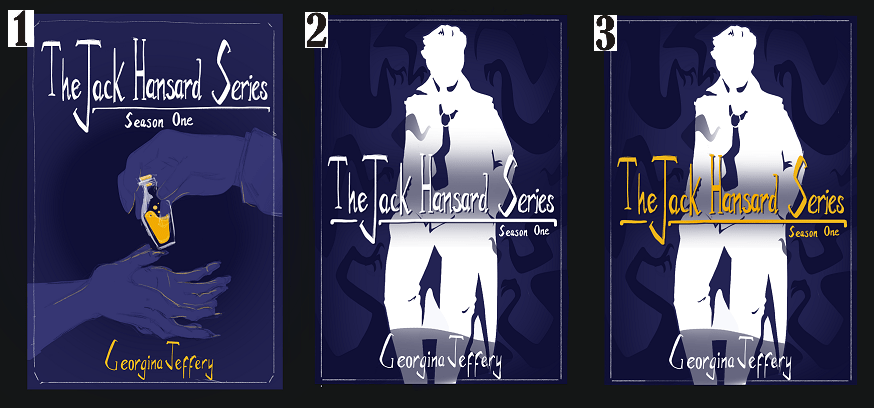
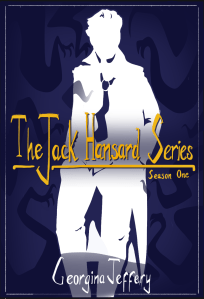
Just over a week ago I asked y’all to give me your opinions on some draft book covers for The Jack Hansard Series – and your response was fantastic! Thank you for all of your messages on the blog, Facebook, Twitter, and Wattpad – we’ve been weighing up your comments and have come to our final decision…
The three cover choices.
Support was almost evenly split between options 1 and 3, with just a few shout-outs for option 2 – clearly the majority of you prefer a splash of colour! The lack of a clear favourite made our decision all the harder, but I’m proud to announce that we’ve firmly agreed on… cover 1!
‘Intrigue’ is the word that kept cropping up in your comments about this design and we heartily agree: it has the atmosphere of those mysterious, underhand dealings that define Jack Hansard. I’m a little bit sore to leave cover 3 behind (I can’t overstate how much I loved all of the options Dom presented me with) but who knows – future poster material, perhaps?
We’re taking this design to the next level.
What happens now?
Dom’s job is to evolve this concept into the final polished cover, and mine is give the series a final edit to make it perfect for publication. Watch this space – we’ll keep you updated as we go.
Hit that big ol’ Follow button if you don’t want to miss anything. You can also watch out for sneak-peeks and other news via Facebook and Twitter!
This is an update for all you fantastic people following the progress of The Jack Hansard Series.
Firstly: thank you for your amazing support! It means a lot that you’ve stuck with me (and Jack) throughout this weird journey. I’ve just recently finished editing Season 1, and so have turned my sights to self-publishing.
Joining me on this venture is artist Dominique Lane. She’s well overdue for a formal introduction (I’ve her to thank for the kick-ass landing page of this website) so I’ll be sure to set up a little ‘Meet the Artist’ feature next.
The focus of today’s post is a little more practical, and involves audience participation!
Dom’s been working hard on book cover concepts, and we’ve narrowed it down to three which I’d like to show you today. The following images are all drafts – we can expect the final product to look somewhat different with more colour and cleaner lines – but they represent the designs we are considering. And we’d love to know what YOU think of them! Take a look:
Draft 1
Draft 2
Draft 3
Which one do you prefer? Can you tell us why?
This is your chance to affect the final product. I’m not just asking because I can’t decide (although honestly, I really can’t; they’re all way better than I even hoped for!)
We really do value your input – because after all, this cover is for you. So it ought to be something that you like 😉
Everything is awesome? Writers and publishers harness the power of the crowd
When writers consider publishing options there are two main routes that spring to mind: you either go traditional, or you go it alone. But the world of publishing isn’t as firmly divided as you might think. Among the host of options available to authors, crowdfunding is now one of them – and prospective publishers are beginning to take notice.
Unboundis one such publisher, and they’ve got a great twist on the crowdfunding trend. Like a traditional publishing house, you must first submit your book proposal for approval. If you are accepted, then the fun begins: you launch your crowdfunding campaign.
If you’re familiar with Kickstarter (and it seems most people are, these days) then you already have a good idea of what this entails. You pitch your book idea to potential readers and do your utmost to persuade them to pledge funds towards your book in return for rewards. Rewards usually include a digital or physical copy of the book, and the more creative authors offer things like exclusive artwork, manuscript tutelage – and in some cases a date with the author themselves!
If you manage to hit your target, Unbound step in to provide all the services you’d expect from a traditional publisher. Editing, graphic design, printing, distribution, and marketing is all covered by the Unbound team.
To find out more about this process I spoke with Erinna Mettler, an Unbound author who successfully met the crowdfunding target for her short story collection Fifteen Minutes, and is now in the editorial phase. She gives us an insight into her experiences so far:
Erinna, why did you choose to publish with Unbound?
Erinna Mettler, author of Starlings and Fifteen Minutes
“It’s extremely hard to find an agent or a publisher in the UK for short stories unless you are already a known writer. It’s a great shame really but agents simply won’t look at new collections and most publishers aren’t that keen either. ‘Come back when you’ve written a novel’ (preferably a crime thriller – with ‘girl’ in the title!) is the way most queries get answered.
I was sick of trying to get an agent. I think that short fiction writers have to work a lot harder than other writers to get published. We’ll try anything.
A fellow author told me about Unbound. I had a look at their website and was sold in minutes. They have a promo video explaining the way they work and it says something like ‘authors write the books they want to write and readers get to read real books that in a crowded, celebrity-obsessed marketplace wouldn’t normally get to see the light of day.’ I sent my manuscript in immediately.”
What was the toughest part of the process?
“Getting the pledges was definitely the hardest part. It took four months in all and it was a full-time job – or at least every spare minute was spent in the pursuit of pledges. At the same time you have to be mindful of bugging people too much. It’s a fine balance. You spend a lot of time explaining what crowdfunding is and why you can’t just publish the book without it.
Family and friends are your first point of contact and for the most part they were very accommodating. The generosity is astounding, you get pledges from people you don’t expect – but then you also get no response from people you think will be right behind you. Some people say they’ll pledge and don’t.
You have to learn not to take it personally. I only had one very rude reply from someone who was on a professional mailing list, telling me off for begging and hoping the project failed; needless to say it just made me more determined to succeed. One of out a few hundred isn’t so bad.”
How did you approach the challenge of reaching your funding target?
“I thought it would be a lot easier than it was. I have a lot of social media followers. I co-run The Brighton Prize for short stories and a spoken word group called Rattle Tales and we have a considerable mailing list. I’m also in a professional group in Brighton called The Beach Hut Writers. I’ve got a lot of contacts but after the second round of emails I was no-where near even half way, so I had to go all out.
I sent out press-releases and got on local radio and had a short film made about the project by Latest TV. I wrote articles for craft magazines and websites, did blog interviews, got short stories placed in literary journals. I called in any favour I could think of.
For me though, Twitter was the key. I’m a writing mentor and my biggest pledge options were for manuscript appraisals. A Twitter friend mentioned that I should be pushing these rather than the short story angle I’d been going for and after a day of constant tweeting I’d sold about £800 worth of mentoring. I carried on with what I’d been doing, but those big pledges are the ones that make the real difference to your percentages.”
Middle tier rewards for Fifteen Minutes
Does a writer need to already have a strong fan base in order to be successful with Unbound?
“I don’t think it’s absolutely necessary but it helps. I had quite a good fan base but I still struggled, so if you are starting out from scratch it could be very soul destroying. My advice would be to start as soon as you can building a social media following, blog regularly, comment and converse, go to events, be bold.”
Fifteen Minutes is now in the editorial stage as Unbound prepares it for sale. What has it been like to work with Unbound through this process?
“It has been an incredible editorial experience. They give you a lot of encouragement if you ask for it at the early stages of the funding but don’t expect them to do the work for you, this is about you being able to raise the funds. Once the funding target was met I had a couple of weeks to submit because the manuscript was as ready as I could make it.
It’s been edited 3 times now, each one more in depth than the other. I’ve had two editors look at it. I agreed with most of the suggestions but not all. It’s a collaboration and the book is a million times better than it was before the edit. We have cut whole stories and changed POVs and the order is completely different. The book is at proof reading stage now but I haven’t seen any cover designs and I don’t know when it will be released yet.”
Your first book Starlings was produced by indie publisher Revenge Ink. Crowdfunding aside, how has your experience of publishing with Unbound differed, if at all?
Starlings was published in paperback by small press Revenge Ink (image credit)
“There’s not that much difference: both are indie publishers and both had a subversive take on publishing, their aims being to push boundaries and publish books that otherwise wouldn’t be.
In both cases things moved very fast. With big companies it takes over two years to get the book out, whereas both of mine will have taken less than a year. You need to be prepared – one minute you’re waiting for emails and the next your book is coming out next week.
The edit was less stringent for Starlings and Revenge Ink had very little money for publicity. I was so new to it all then: now I know that to make it work I’ll have to be responsible for my own marketing. Unless you are already a big name, most authors have to undertake their own marketing as budgets for new authors are almost non-existent.
I had a strong relationship with Amita, the MD of Revenge Ink, and she was nothing but supportive. The Unbound team are all very enthusiastic and really help you move forward with the project. I’m hoping the book will get a little bit more publicity this time.”
In the race to gain pledges, you’ve essentially done all of the sales work so far. How will Unbound help sell your book after publishing?
“Fifteen Minutes is an e-book so I’m currently teaching myself how to market an e-book. I have to wait until there’s a review copy available to send out to reviewers, journals, radio stations. It’s the usual dive-in strategy. There will be paperback copies available for events and signings. I’m hoping Unbound can help with contacts that might get the book seen.”
Is there a community of loyal Unbound readers? People who look out specifically for new and interesting Unbound projects, in the same way Kickstarter has a strong base of funders who are very attached to the platform itself?
“I went to the Unbound birthday party in November and they had invited their top pledgers to come along and meet their authors. It was great talking to them; they are completely committed to this kind of publishing. If you look in the back of the books the same names do keep coming up. Some people will only be drawn to the author they know, but I think more and more are going to be drawn to the crowdfunding concept and to the idea that this will be the place where interesting books are distributed from.
If you mention Unbound to anyone in publishing the praise is almost universal. The company is only five years old so it’s early days, but their sales are increasing year on year.”
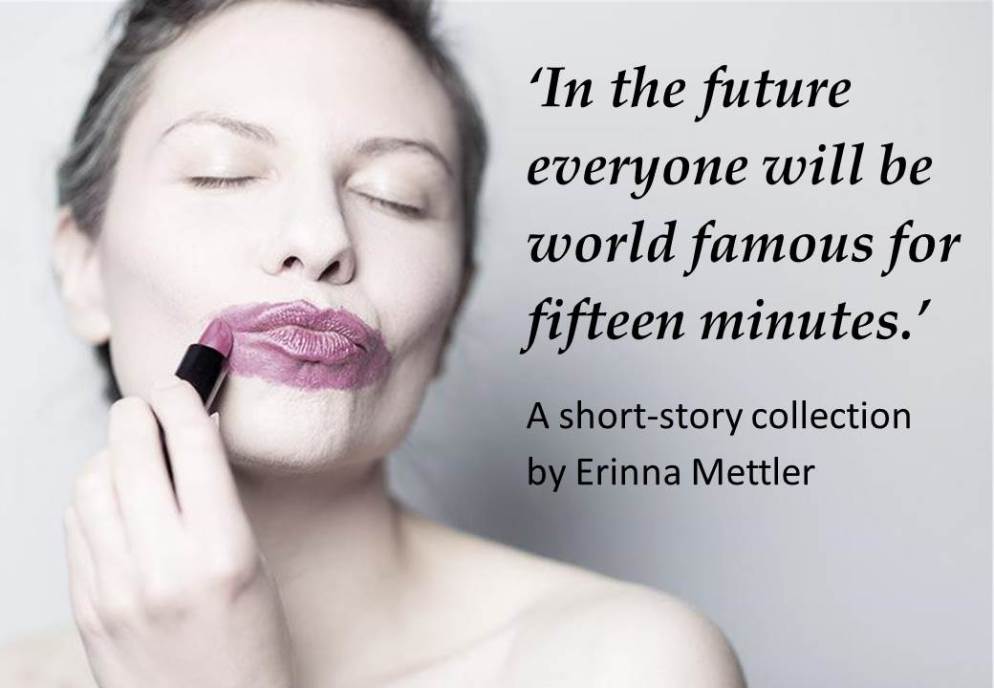
Fifteen Minutes by Erinna Mettler is a collection of short stories about fame and how it affects ordinary people.
Often the famous have only a bit part in the tale of an ordinary individual, existing just outside the action but still influencing the outcome. From the story of a tramp in New York on the day John Lennon was shot, to a doctor remembering a childhood visit to a Muhammad Ali fight, and a woman’s obsession with Harry Potter following the death of a child. The collection is experimental, cinematic, moving and always thought provoking. You can support Erinna’s book by making a pledge through her Unbound page.













 Georgina Jeffery