The penultimate installment of the Jack Hansard series is now up! In Episode 19: Little Fish Hansard and co. finally come face to face with the phoenix creature they’ve been seeking . . . but it’s not quite what the old stories described. Hansard just might be more out of his depth than he realises.
Sorry for the wait, the engagement and then Christmas prep sort of got the better of me (but Yay, engagement! and Yay, Christmas!). The final episode of Series 1 will be added in the new year. Hope it’s an enjoyable read.
This evening I was supposed to finish editing and upload Episode 19 of the Jack Hansard Series . . . but I haven’t, because a LIFE EVENT has happened to me.
My partner, Jake, against his better judgement and general common sense, decided to propose to me today. And I, against my better judgement and general common sense, accepted.
An evening of rollicking debauchery followed (we had a bottle of port and rang round our relatives, exciting stuff). Unfortunately this means I’m postponing Episode 19 until, I don’t know when – maybe tomorrow, maybe this weekend. It won’t be long, anyhow.
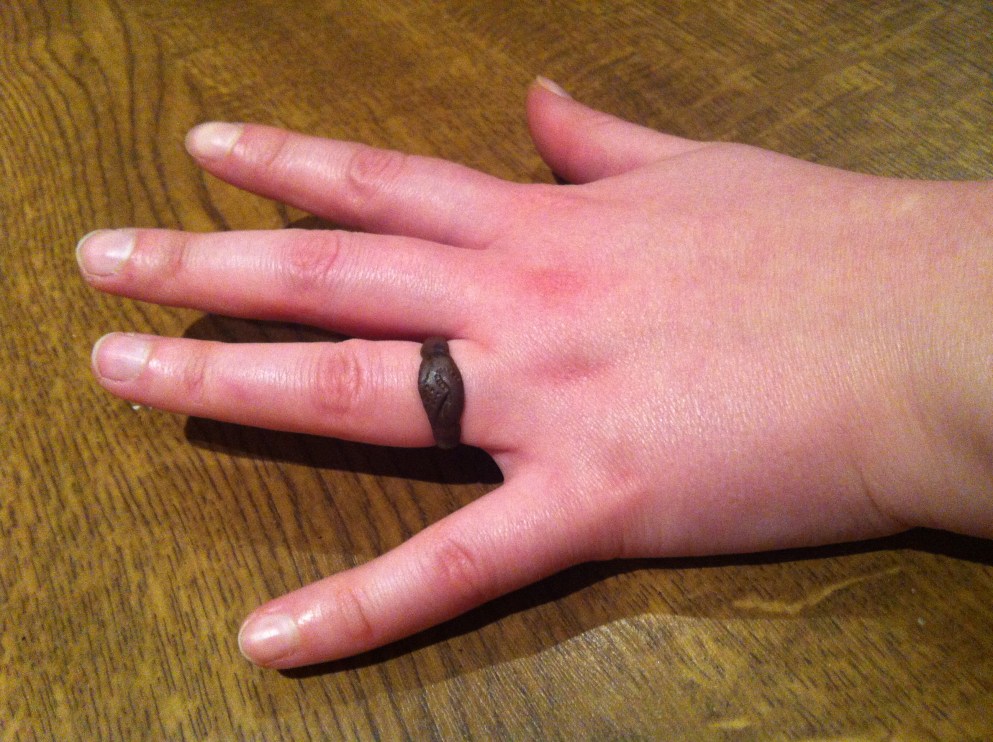
If you’re the type of person who like these things, here’s the ring – as unconventional as we are.
It’s a medieval ring of the ‘clasped hands’ type, otherwise known as a fede ring. (So it’s not even new! He bought me a second-hand ring! But just try telling me it isn’t cool to be presented with a ring that was probably used in a betrothal some 600 years ago.)
So there we are, achievement unlocked, onto the next level of the game. Hope I’ve unlocked some cool new superpowers to go with it. (Just call me huldra.)
Take care all, you’ll hear from me again soon~
P.S. The two catch-phrases of the evening: “When’s the wedding?” and “How’re the chickens?” . . . People are weird xD
I’ve been wondering about short stories in the publishing landscape for a while now. At first I was all, “Well of course short stories would be hard to sell,” but since I realised how much I and others I know love to consume them, that big ol’ “WHY?” has been forming in my brain. Erinna Mettler makes a fantastic, rightfully indignant point.
On Friday, checking in with Twitter, I came across #Authorday, which invited tweeters to ask agents from Peters Fraser & Dunlop questions about their work. I am presently sending out a themed collection of short stories so I thought I’d ask the obvious.
#Authorday how come agents hate short story collections when the best do actually sell better than bad genre?
The answer?
Because finding a publisher to buy them is like putting a magnet to a haystack for that elusive needle.
I replied that as it was once again the year of the short story it should be getting easier for agents to get publishers interested and asked if it wasn’t a matter of pre-conception all round? Another short story writer commented that he too was disappointed by the lack of mainstream push for the genre. Neither of us got any further response.
The Jack Hansard Series is now up to Episode 18, and I’m feeling like a proud mother in the weeks leading up to graduation. Better yet, I feel like the student who knows their long slog of essays and deadlines is finally drawing to an end. Bit of relief, bit of pride, a bit of last minute nerves and anticipation.
There are just two more installments to go this year: Episode 20 in December will bring to a close what I’ve affectionately come to call Season 1. When I started writing in January, I didn’t know if I’d get this far. I’ve been testing myself the whole way, daring myself to fail and let not just myself down, but all those who’ve helped to push me, encourage me along.
I know I’ve not got much of an audience – I’m not kidding myself with illusions of grandeur here – but I hope that what audience I do have is enjoying what I have to offer. Ultimately, that’s what really concerns me: not how wide my readership is, but whether I can entertain and amuse you in the same tradition of countless authors who have brought bursts of colour to my life. I want to pass the parcel on; the best thing is seeing the smile on the person who gets to unwrap the next layer. The worst thing is seeing them disappointed by the shitty plastic whistle inside.
So, small and silent as you are, I don’t want to disappoint you with some shitty ending (I can at least promise it won’t be a plastic whistle). I hope you’ve been enjoying the ride as much as me, and I’ll try and make our shared finale as explosively colourful as possible.
Yesterday was nothing short of an ordeal. Yesterday was the fruition of a challenge I privately set my self a month ago:
Go to Comic Con. Hand out some Jack Hansard reading material.
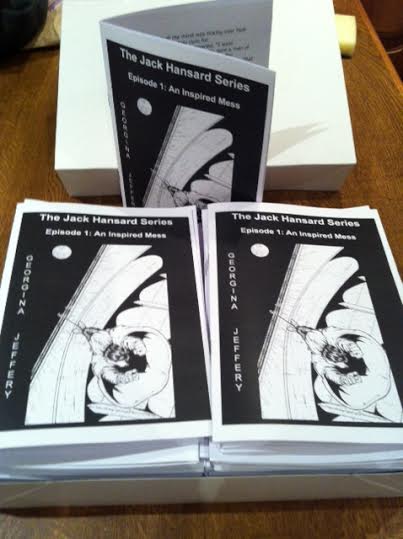
That’s it. No physical trials, no emotional trauma involved. I’d got my zines ready – a basic little publication with Episode 1 of the series tucked inside – and all I’d have to do is hand them out over the course of a day, while taking in the awesome sights of the con at the same time. Easy-peasy, right?
That’s what I thought.
It seemed like a sensible plan. From the very beginning, An Inspired Mess has been a project in self-confidence, in learning how to say ‘Look at me’ without shrinking away from the limelight. It’s an attempt to learn how to accept the idea of being read, and judged, and criticised, and not running away from the prospect of failure.
Step 1: write something and put it somewhere public. You can put a big ol’ tick next to that one. The Jack Hansard Series is now 17 episodes and counting, all free to read for anyone who wants to.
Trouble is, it’s easy to throw your work out into the vast ocean that is the world-wide web. You’ll be swallowed by the currents – torrents – of other content, and you can sit back and relax, knowing that you’re drowning in safe anonymity and insignificance.
When I realised Comic Con was going to be within travelling distance in November, a nugget of rebellion formed in my mind. Stop playing it safe, it said. Are you really content with staying here in your sheltered hidey-hole, all comfy knowing you’re not attracting any real attention? Are you happy being a coward?
If you ever want to push my buttons, just call me afraid. I’ve climbed mountains just to give vertigo a good old punch to the face. I’ve done stunt-falls from high castle walls just to prove I was better than the knots in my stomach. And yesterday, I went to Comic Con to prove that I’m not afraid of being read.
Boy, was I in for a surprise.
I arrived about 12:30, happily admitted with no queues, and was first hit by the size of the hall. I’ve never been to a con as big as this. I’m used to conventions that take up, say, a hotel, where the atmosphere feels more intimate; friendlier, perhaps. I knew right away that this wasn’t going to go down the way it had in my head. I thought I was going to pick a spot, hand out a hundred zines in an hour, and then go enjoy myself.
I did the opposite. I spent the first hour browsing the colourful stalls and admiring the awesome costumes . . . all the while my stomach was steadily twisting and tightening with sickly fear. It was horrible, psyching myself up to start handing out the first few copies. I’ll hand them out as I’m walking, I thought. It’ll be easier to keep moving.
Wrong. I began to offer some out, and before I’d got rid of even ten I felt the desperate urge to run and hide in the toilets for the rest of the day. I’ve now got some serious respect for those people who hand out literature for a living. We’ve become so conditioned to expecting spam that our gut-reaction is to be intensely wary of anyone handing out anything.
“Hi there, would you like a free story?” I’d ask.
Some people took it with a look of deep suspicion, like they were expecting it to explode. The most demotivating reactions were those who just . . . ignored me. I wondered, as I kept on smiling, when did people suddenly stop wanting free stuff? Worse than that were the reactions my imagination was conjuring for me. Images of these poor people reading my little crapfest of a short story and sneering in disgust, throwing it away, calling it a piece of junk. Suddenly I didn’t want anybody to read it at all.
I felt pretty worthless. I’d misjudged what people wanted, and I’d misjudged what I was capable of. I spent five minutes gearing up to every person I approached. Each encounter felt draining, whether they took the free zine or not. Thirty minutes in, I felt like the biggest idiot at the whole event. There should’ve been an arrow over my head; people could’ve paid to take a picture with me.
In the end, it was my partner who made me keep going.
“You haven’t handed one out in the last ten minutes,” he said. “Give one to that guy there. You can do this.”
“You’d tell me if I was being an idiot, right?”
“Yes.“
Whatever doubts I have about myself, I trust his judgement. I kept going. And after a little while . . . it got easier.
“Would you like a free story?”
“Always!”
It always startled me, but the occasional positive response really lifted my mood, and they became a bit more frequent as I stuck it out. One person even tapped me on the shoulder and asked for a copy. Just at a moment when I was flagging, too. Weird how such a small thing can give you a new lease of life.
My favourite encounter was with a sixteen-year old Harley Quinn with a ‘Free Hugs’ sign.
“Trade you a free story for a free hug?” I asked cheerfully. I felt I’d gotten the hang of it by this point.
As we got talking, I learned that Miss Quinn was fighting her own battle: she was teaching herself to get used to physical contact.
“I’m not good with being touched by people,” she explained. “My uncle’s only had about four hugs from me in my entire life. I decided this morning that I’d try to help myself get over it at the con.”
How cool is that? Here we were, two people giving away a free thing, both for similar reasons, facing fears and fighting our own personal battles. She told me she’d gotten a lot better in the few hours she’d been at it. While talking to her, I realised I had, too.
I don’t expect a sudden upsurge in readership due to my endeavours, but I don’t feel that I’ve failed, either. Because ultimately, the ordeal had turned into a lesson. My aim of the day was to drum up some interest, to actively seek out an audience. Instead, I came away with a better appreciation for what the job requires, and an idea of how I could improve it. The most valuable lessons: 1) Handing out literature is tough. 2) Relax. Who cares if one stranger doesn’t like your material? You won’t see them ever again. 3) Have some faith in yourself. You can do it.
So if you’re someone like me, another insignificant writer trying to drum up an audience, I hope this has been a useful account to you. Don’t be afraid of putting yourself out there. Persevere, and it’ll get easier. The worst that can happen? You learn how to do better next time.
And if you’re one of those people who kindly accepted a Jack Hansard episode from me, I’d firstly like to apologise, just in case I seemed at all rude – I was a bit scared, and just trying to get it over with. And secondly I’d like to thank you, for allowing me to intrude on your life for just a moment to ask you to read me. Most of all, I hope that I don’t disappoint. Because that’s one fear I’m not sure I’ll ever be able to beat.
Is that a pod racer behind me? Why yes, yes it is.
Peggy’s face lit up. I don’t think she gets enough opportunity to show off all that knowledge she stores up from being around books all day. “Well, the phoenix is a mythical regenerating bird that is said to live forever. Or rather, it begets a new phoenix from the remains of the old, sort of asexually reproducing. Most commonly it’s thought to die in a burst of flame and then be reborn anew in the ashes. Tales about the phoenix range across the world and through the ages: there’s the Greek historian Herodotus who suggests the phoenix is native to Arabia but flies to Egypt to be reborn; Pliny the Elder catalogues a possible live specimen sent to the Roman Emperor Claudius (but that one’s probably a fake); it crops up in all sorts of medieval bestiaries, and of course in religious imagery and symbolism, you know how popular the idea of rebirth is–”
“Myffical, ye said,” Ang pointed out flatly.
“Well–”
“That’s the interesting part,” I interposed. “Despite all the stories, general consensus is that the thing doesn’t exist. You’d think it’d have turned up on the Black Market by now, if it did.”
It looks like Hansard’s been tasked with finding the legendary regenerating firebird, the phoenix. I bet you could give me the low-down on this one yourself. The phoenix lives forever, it ‘dies’ in a burst of flames, and it’s reborn from its own ashes. Just like the lovable Fawkes from Harry Potter. Right?
Right. Well, sort of.
The above clip, Peggy’s explanation from Episode 17, gives you the bare bones of some of the earliest accounts of the mythical phoenix. Travelling historian Herodotus ranks the phoenix among the sacred animals of the Eyptians (we’re talking 5th century B.C. here), though he takes care to mention he’s never seen the bird himself and he’s just retelling what the locals told him. According to his report, the phoenix has gold and red feathers and is about the size of an eagle. It apparently lives in Arabia and flies to a specific Egyptian temple (the temple of the Sun in Heliopolis) once every five hundred years. It makes this journey in order to rebirth its parent – the phoenix makes a shell out of myrrh and puts its parent inside, then carries it to the temple of the Sun. That’s all Herodotus says on the matter.
The implication seems to be that the old parent bird will be born anew from the egg of myrrh. The fact that this happens every five hundred years suggests the lifespan of the phoenix could be one millennium. (Think about it: the new bird hatches and flies back to Arabia – it brings its parent back to the temple in five hundred years; then five hundred years later the original phoenix is brought by its child to the temple.)
So far, no explicit mention of immortality, and certainly no flames or rising from the ashes involved.
It’s through this link with Egypt – and Heliopolis in particular – that we might find the deeper origins of the phoenix story. Heliopolis (or ‘City of the Sun’) was a big center of worship for the Egyptian sun-god Ra. The Egyptians had a sacred bird called the Bennu, a divine being that formed part of the soul of Ra. Predictably, the Bennu is associated with themes of creation and rebirth and may have been worshipped at Heliopolis as well. Seems probable that this strong link to the sun is what could have later led to the fiery nature of the phoenix. The Bennu bird looks more like a purple heron than the majestic, eagle-like form of the traditional phoenix, but I reckon it’s not too big a leap if you squint.
Back to the actual phoenix. Sorry, tangents. Can you tell I studied Ancient History? Totally putting that degree to good use.
In the clip above Peggy also mentions Pliny the Elder, another contemporary historian who records a ‘real’ phoenix presented to Roman Emperor Claudius (knocking around in the 1st century A.D.) but he rejects this ‘live specimen’ as an obvious fake. He gives us some more hearsay on the bird though, describing it as gold and purple over the body, with a long blue tail and a crest on the throat and neck. He tells us it has a sacred link to the sun (hello, Bennu origins?) and that when it’s time to die the phoenix will build a nest out of spices and perfumes, then lay down and die on it. From the nest a small worm emerges; the worm becomes a small bird, and then a full-grown phoenix. Still no fire.
Fast-forwarding a little to medieval Europe the story has morphed to include flames, and the echoes of both the Greek phoenix and the Egyptian Bennu run through it. Take this entry from the Aberdeen Bestiary (c. 1200 A.D.) as a prime example:
“The phoenix is a bird of Arabia, so called either because its colouring is Phoenician purple, or because there is only one of its kind in the whole world.
It lives for upwards of five hundred years, and when it observes that it has grown old, it erects a funeral pyre for itself from small branches of aromatic plants, and having turned to face the rays of the sun, beating its wings, it deliberately fans the flames for itself and is consumed in the fire.”
By this point in time the phoenix had become a popular symbol of rebirth across the world and in Christian and Jewish symbolism. Can’t tell you when fire became such a huge part of the story, though. Would be great if I could point at a specific record and go, “that one, guv”. Anyone out there got any leads on the subject?
Our snippet ends here, because if I go on any longer it’ll become an essay rather than a snippet. If you want to read more, there’s this book available through google.books preview that seems pretty interesting.
Thanks for reading; here’s hoping I managed to tell you something you didn’t already know 😛
From the yellowed pages of a leather bound journal, I stare outwards with unbridled, ugly jealousy. On a cold November day I was captured, unwilling; immortalised in the shutter click of a camera. Frozen between pages, between seconds, and left to gather dust.
Now, fifty years on, she is still living my life outside the photo album, while I, in my sepia prison, must endure the grubby caress of her grandchildren.
If you enjoy writing prompts, post your own story on the theme of Photographs in the comments! 100 words or less 😉
The shame was the worst of it. The tangible odour of disgrace. As if the searing, spiky, red-hot rod of embarrassment lancing through my chest wasn’t enough.
It’s downright scandalous. The whole world saw, I just know. They all saw me in my moment of weakness, bare, uncovered, like a primitive. No doubt they’re talking about it now; I can feel their little barbed words piercing the air around me.
“How could anyone be so careless?” they’ll say. “Clearly an attention-whore,” they’d conclude. “Absolutely disgusting.”
They’d be right. It was disgusting. Lewd. The lowest point of depravity. And what’s worse, it happened at the seaside. Where children could see it.
I could have prevented it. If only I hadn’t left the top buttons of my shirt undone, if only the air hadn’t been so humid, if only it hadn’t been such perfect holiday sunshine weather – this whole ghastly affair could have been avoided!
But no. All it takes is for the fabric to catch on one unfortunately placed nail, to tear, to rip, to reveal to the entire beach of innocent holiday-makers the monstrosity that lies beneath.
A nipple.
My nipple.
Exposed, defiant, and without justification. Resplendent in its pink aereolic glory. Alas, the light dusting of sand did nothing to hide my shame.
I covered it as quick as I could, of course. We all would. My hand slapped straight to my chest. I swear I felt the blood drain from my cheeks in pure horror, while simultaneously rushing to them in abject humiliation.
The damage was done. No one would ever look at me the same way again.
You’d think that a nipple shouldn’t be something to write home about. I mean, we all have them. We all know what they look like. They are pink little protruding bobbles in our skin. They don’t smell, they don’t make a noise: in many ways they are really quite innocuous. But seeing a foreign one always causes us to stare.
To say, ‘I know what your nipples look like,’ is somehow incredibly, inexplicably invasive.
I take a long, deep breath. I can get over this. It was just a minor slip. I don’t have to let it ruin my life; I don’t have to let people judge me like that.
As I carefully fix my shirt, my wife turns to me.
“Stop worrying, Dave,” she says with exasperation, and shakes the water from her hair. “No one’s looking at you.”
She sighs a small, private sigh, and then self-consciously tugs the towel tighter around her bikini-clad body.
(Warning! Spoilers ahead for Episode 14 of The Jack Hansard Series.)
It’s been a while since I’ve written one of these Folklore Snippets, but I suppose Hansard hasn’t run into many beasties lately – or at least, no beasties inspired by our own, real world folklore. Hansard’s adventures have begun to take a darker turn and I’ve relished the opportunity to flex my horror muscles. Episode 14: Lament of the Lake features a monster of particularly macabre origins: the lake-dwelling, child-murdering kelpie.
This aquatic terror hales from the high peaks and ice cold waters of Scotland. Like many mythological water-dwellers, the kelpie has the ability to shape-shift and often appears in human form. But if you catch one in its natural guise, kelpies take the shape of a wild horse.
Usually, the human form of a kelpie is male – in most of the tales which were written down in the nineteenth century, at least. Later on, artists began painting kelpies as scantily clad maidens reclining on the rocks, much like the sirens of Greek mythology. You can put this down to either innocent misinterpretation of the stories, or the perversion of renowned artistes and their rich audiences. I know which one my money’s on.
Kelpies sometimes retain their hooves when in human form: a dead give-away to look out for if you’re in the habit of being chatted up by handsome lakeside strangers. Also watch out for water weeds and sand in their hair. Being Scottish, it’s natural that the kelpie inhabits lakes and rivers rather than the coastline. I suppose that makes it a freshwater monster. And monster it certainly is: a common theme to kelpie stories is the drowning of children.
One tactic favoured by the kelpie is to appear at the water’s edge as a beautiful horse; imagine a glossy coat and a shimmering mane. It entices both adults and children to ride on its back, and as soon as you are aboard the kelpie gallops into the depths. It may then eat its hapless victims, allowing their entrails – a lone lung or liver – to wash up on shore afterwards.
Sometimes, the kelpie’s trick is simply to let you stroke it. Who can resist a noble horsey gently nuzzling your hand? But then, much like what happens to Toby Everest’s poor son, your hand sticks fast to the horse’s coat and the kelpie drags you into the water. If you’re quick-witted, you might manage to save yourself from a watery grave by cutting your fingers off – and in some tales this is how the victim survives. But usually the kelpie claims many lives: the kelpie of Sunart is said to have taken nine children. This, and many more tales of tragedy attributed to a water-horse superstition, are compiled in John Campbell’s Superstitions of the Highlands and Islands of Scotland.
Thankfully, cutting off your fingers isn’t the only defence against a kelpie. There are a whole range of options for the monster hunters out there. You can outright kill one of the beasts by shooting it with a silver bullet, or, if one tale about a blacksmith is to be believed, merely poking them with hot iron will do the trick. If you can get the kelpie to appear in horse-form and find it to be wearing tack – that’s a bridle, saddle and other riding accoutrements to us non-horsey folk – remove the tack, and you’ve effectively disabled the kelpie, robbing it of its strength. Plus, that tack might have some nifty magic powers, such as turning humans into horses (or turning yourself half-kelpie, with the gift of second sight!). But what if your kelpie isn’t wearing a bridle? Have no fear – stick one on it! This would apparently capture the kelpie for your own amusement, trapping the creature in its horse shape and forcing it to obey your commands.
So what inspired the inception of this aquatic horror in the first place? The answer, I suspect, is so obvious it’s almost not worth pointing out. When you live in a place like Scotland, a landscape riddled with deep, unforgiving pools, it quickly becomes necessary to scare the bejeezus out of your children to keep them from playing too close to the water’s edge. Careless travellers who go for an ill-fated swim in a nearby lake get sucked into the rich body of folklore, and seeing as there is never a shortage of idiots, and Scotland certainly has no shortage of lakes, it’s a story that writes itself time after time and again.
So let that be a lesson to you, too: in all your wanderings, tread carefully by the lakeside, and be mindful of slippery rocks and treacherous weeds. And never, ever pet a strange horse by the water’s edge.
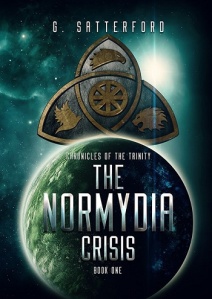
While I’ve been over here in the corner umming and ahhing to myself over the challenge of attempting to become a paid, published author, a friend of mine has thrown caution to the wind and dived in headfirst. Gregory Satterford – fellow re-enactor; ex pro wrestler; fitness instructor – can now add ‘published science fiction author’ to his list of extravagant professions.
I suspect the thought of self-publishing will have crossed the minds of most writers. Who wouldn’t be tempted by the prospect of publishing on your own terms, without the hassle of submitting to multiple agents and publishers; without the gradual erosion of self-esteem as you deal with an inevitable influx of rejections; without the pressure of a publishing house bearing down on you with contracts and deadlines and obligations to fill.
On the flip side, it sounds like all of the above is replaced by the hassle of having to produce your book by yourself. All the proofreading, editing, and formatting is down to you, unless you want to pay extra to outsource those services. Then you’ve got to handle the distribution and marketing of your book, and that’s no task for the faint of heart. I’ve always been curious as to whether the effort required, and the money, to an extent, is worth the end result. What is involved in the process? What do you get for your money? I took the opportunity to grill my newly appointed author friend on his experiences starting out in the indie industry. Here’s what we talked about:
1. Obvious question first. Why did you choose to self-publish?
G. Satterford, author of The Normydia Crisis
“No-one else would have me? Seriously though, I made some forays into various publishers but on discovering the benefits of a publisher were actually not great I decided I would try to go for myself. As far as I can tell I would be paying all the same charges, cover art, advertising, etc. and losing much of my income for the strength of a publisher’s name. In the balance I would rather be able to work my own time-frames and work with my own dreams without interference. In time I may come to regret this, but with the growth of self-publishing I’m hoping to the contrary.”
2. How did you decide which publishing tools to use?
“I chose Amazon Kindle Unlimited because I have been a satisfied user of Amazon Kindle for many years now and they have the most convenient way of publishing work to the widest audience, as far as I can see. Kindle publishing seems tailor made for the independent publisher as the editing is fairly simple for the computer savvy and there would be fewer charges to worry about, such as printing and delivery, so I decided to go the electronic route for my first foray into publishing. I had not planned to publish in paperback until I had released another few books and was more established and confident, but due to demand I located CreateSpace through Amazon as well and found them a helpful company for reformatting and cover work. It turned out paperback was also well catered for, the most difficult part being the page editing to fit their requirements and create a professional appearance.”
3. What can you tell us about your experience with Amazon Kindle Unlimited and CreateSpace?
“Publishing through Kindle has been remarkably stress free, they have an excellent review system to check the formatting and help topics covering most subjects with a responsive help team. It is excellent that I can adjust the manuscript at any time and it will filter through to the purchased copies and the deadline feature for publication really helped to motivate. Kindle Unlimited is a good feature for new authors as people do not need to buy the book and it is interesting to see how it is developing, but they do not allow usage of other ebook vendors such as Google. This is restrictive so people will need to decide which way they would rather go, but I felt I would experiment with them for a while as it seems a good option for a new name like myself in publishing.
Createspace is fairly easy to sign on to and use, and the staff are very helpful. The only issues I found were trying to adjust and match the formats from Word with their book layouts, requiring a few proofs before we got it right, but that is all just part of the learning experience. Cover art proved very different when printed in particular, with gloss and matte options and other similar things making it a bit more complicated. Once you get the hang of their system it’s a lot simpler, it just takes some patience.”
4. What costs were involved in the process?
“Aside from the writing software I also needed to spend money on my cover art (being an appalling artist myself), editing, proof-reading, and advertising mainly. The art was done through 99designs where I auctioned the image idea and discovered many fascinating interpretations from various artists, then selected the one I liked best. Then there are potential costs for editors and proof-readers but I was able to minimise these by enlisting the help of friends and family. I would recommend a professional if you have the funding available as no matter how devoted family and friends may be some errors will get through, whereas someone under contract has his payment hanging on his accuracy, which is an excellent motivator for scrutiny. Advertising is proving the easiest cost to run away with as there are so many methods of varying effectiveness around the web. The actual publishing is free to use through Amazon and CreateSpace: the companies take a percentage of your book sales only.”
5. Part of the appeal of traditional publishing is that the publisher handles a lot of the legwork, especially where it comes to distributing and marketing a book. Self-published authors seem to have to take on a lot of extra labour – how have you dealt with that workload?
“I’ve actually found publishers I checked do not help with advertising beyond a page on the website and some advice on book signings, etc. Most indie authors I’ve spoken to have the same legwork as traditional ones. I’d say the hardest to work on was editing my own work and making it good for publishing, requiring a strict timetable to hit my deadline.”
6. How do you support yourself while writing? I’m guessing the new book might not be drawing in $$$ straight away.
“At the moment I’ve only been published for a few months so I’m still putting the sales aside to pay fees. I am continuing to work as a fitness instructor for the majority of my income while writing when I can.”
7. Do you think the cost and overall effort has been worth it?
“Yes. No matter what the result I’ve enjoyed writing my work tremendously; creating a large universe of lore beyond anything I expected to do when I started. I’ve got a 5 star review that pleases me more than I can explain and I hope that it is received favourably in the future so I can continue to explore the galaxy with my readers.”
8. And finally, in 50 words, tell us what your book is about~
“It is based in a dark future where genetic engineering has created three castes of humankind: pure Lowborn, the enhanced Highborn, and the mysterious Bloodborn. Book One introduces this galaxy and prepares the four characters for a rebellion in a vassal world amid an alien invasion and great social upheaval.”
If you want to find out more about Greg’s work you can follow him on social media, or check his website for some free short stories related to the Normydia series.
P.S. Are you an author in either traditional or indie publishing? I’d be interested in hearing how your legwork compares to Greg’s – is it true that big publishers don’t necessarily offer much support? How crucial is that big name to drive sales?




 Georgina Jeffery