Dydh ha, my lovelies! Just popping my head above the surface to let you all know that I’m still here, and that An Inspired Mess is far from sitting quiet. I’m now halfway through editing TheJack Hansard Series: just ten more episodes to go! Every week I upload the polished edit of another episode that you can read for free – keep an eye on the Home Page to see which one has been most recently updated.
I’m currently collating my editing experience (read: mistakes) into Editing Tips Part 3: The Hard Cut. This article will cover the heart-wrenching aspects of editing, the changes we can’t always bring ourselves to make. Stay tuned, I’ll have it ready soon.
As you may have guessed from my infrequent blog updates, I am far from an avid blogger – I do enjoy reading and writing articles, but my heart definitely lies with fiction. The downside is that by not blogging as often, I’m making it harder for myself to reach out to y’all!
I’d like to find more ways to connect with like-minded readers and writers both in and outside of the blogging sphere . . . so here’s a question for you: If you’re a reader, where do you prefer to connect with authors? How do you like to be kept updated about their work?
And if you’re a writer, what platforms do you use to reach out to your readers? For my tuppence: I’ve recently joined Wattpad, and I’m finding it fantastic for making friends and joining engaging conversations. Conversation, I think, is the key. There’s no point in reaching out to your audience if you’re not willing to invest some time in getting to know them.
So if you want to chat, hit me up! You can reach me on:
Editing is a skill that you need as a writer, regardless of whether you intend to self-publish or not. The first draft will never be your best (it certainly isn’t for most great writers) because it’s the editing that makes it great. In this three-part series we’re looking at three keys elements of fiction editing, with some simple guidelines that will help you hone your work from first draft to final.
The Easy Cut is a simple first step you can take to tidy up your work. You’re looking specifically to cut bits out in order to streamline the text and make it flow more smoothly. The word I like to use is tight – you’re tightening up the writing.
So what kind of things should make the Easy Cut?
Cut the Unnecessary
A good rule of thumb is to remove words that are unnecessary, or redundant. See that sentence you just read? That’s a prime example. The words ‘unnecessary’ and ‘redundant’ essentially mean the same, why do I need both?
You don’t need to apply this rule to everything, but you’ll find most paragraphs read better once you have. A couple more examples:
Try saying ‘they gathered’ instead of ‘they gathered together.’
Because the ‘together’ is already implied by the verb of having gathered.
Try cutting words like ‘quite’. Eg: ‘He quite liked the look of it . . .’; ‘She was quite artistic . . .’
Ask yourself, why are you qualifying your statement with ‘quite’? Is your character artistic, or is she not?
I am so guilty of having too many ‘quites’ in my writing. I could argue that it’s part of my character’s voice, but really it’s my own creeping in. You can (quite!) often remove this word and end up with a punchier sentence.
Cut the Repetitive
Pay attention to where you may have repeated the same kind of word within a short space. Read the paragraph below and think about how easily you could improve it by changing the repeated word:
The wind was howling outside the bedroom windrow. Melissa shivered and pulled the covers up to her chest, stealing a glance at the clock. Almost time. When would he arrive? Would he come at all? Finally the clock struck midnight, and the wind howled louder. She couldn’t remember when the town had last been struck by such a howling gale.
That’s a very exaggerated example, but not uncommon: the writer is overly intent on creating atmosphere with the howling wind and can’t let go of the word. Do we need all those howls? If you are certain you have to describe the wind at those three points, perhaps you could vary your description? Instead of howling, perhaps the second time it roars. Instead of sound, perhaps you can show us the chill it pushes through the window. Maybe the shadows of tree branches clawing at the walls.
This is one of the easy jobs you can give your Beta Readers – ask them to highlight words they think you’ve used too often, or too close together.
Cut the Weak Action
Another way to make the Easy Cut is to get rid of some of your adverbs. Adverbs are often rather weak descriptors and can be replaced by a much more expressive verb. For example:
‘He walked slowly . . .’ could become ‘He ambled . . .’ ‘She said quietly . . .’ might be better as ‘She murmured . . .’ ‘He leaned forward quickly . . .’ becomes way more assertive as ‘He lunged . . .’
Here’s a nice little resource that might help you find the active verb you’re looking for to replace some of your duller adverbs.
And if in doubt, pick up a thesaurus! (Or search for synonyms on Google.)
Cut the Weak Description
Similar to above, look out for where your adjectives have words like ‘very’ in front of them. Is there a better, stronger adjective you could use – one that punches harder?
‘very hot’ could become ‘scorching’ ‘very small’ could be ‘minuscule’ ‘very angry’ could be ‘fuming’
There is a certain satisfaction to be gained from being precise with your phrasing. Why just be close to what you mean, when you could say exactly what you mean?
Cut the Dialogue Tags
Sometimes less is more, especially where dialogue is concerned – at least, where your dialogue tags are concerned. A dialogue tag is a word that attaches to dialogue primarily to identify the speaker, and sometimes to convey tone of voice. Words like: remarked, demanded, exclaimed, muttered . . . you know, all the ones your English teachers drilled into you to replace boring old ‘said’.
Thing is, there’s nothing wrong with ‘said’. Go pick up a book and flick to some dialogue. Read a page or so. I’ll wait.
Bets are that the section you just read included more ‘said’s than any other kind of tag. Also likely that it didn’t include many tags at all. There’s a simple reason for this: dialogue tags are distracting and can break up a nice flow of speech. Your eye is trained to slide right over ‘said’; it gets stuck on words like ‘shouted’. So this means that if you spend every other line telling the reader how she shouted then he exclaimed then she raged then he groused then she screamed . . . you don’t get an intense argument, you get a string of lumbering, clunky verbs.
An expressive tag carries a hell of a lot more weight if it occurs in isolation. Use them wisely to add impact at key moments in your characters’ conversations.
Cut the Stalling
If up to now you’ve been staring at your first draft wondering how you could possibly improve it, start with the simple cuts I’ve suggested here. By all means, don’t cut everything that falls under these guidelines – you have to learn to trust your gut, after all. But this should help you recognise the places where you can tighten up your writing, and hopefully I’ve helped you understand why some things will read more smoothly than others.
So what are you waiting for? While your Beta Readers are still plowing through your work, you can be getting on with your Easy Cut.
Save your tears for Part 3: The Hard Cut.
Are there any tips you’d like to add for other writers going through the Easy Cut? Share them in the comments!
If you want to be notified when Jack Hansard episodes have been updated with their final edits, you can follow the AIM Facebook Page to receive these updates, or check the An Inspired Mess homepage each Monday for a link to the most recent one. =)
I thoroughly believe this. The first draft from even the best of writers is likely to be a pile of crap – and that’s because they know the important thing is to get that first draft finished, not perfect. If you are constantly polishing and editing as you write, you run the risk of never being satisfied with what you’ve created, and in the end you create nothing.
You may have seen this video by Jake Parker doing the rounds; if not, watch it and get pumped.
This is why I think the second key to good writing is to let the first draft be crap. Just get it out there, in the open, onto that blank page. This is why exercises like NaNoWriMo are brilliant: it encourages you to pour your soul out and get something finished in a set time-frame, to a deadline.
That’s what I set out to do with the Jack Hansard Series, and I’ve now completed that first crucial step. Season 1 is finished, exposed, and ready for stage two. The Big Edit.
If you’re a regular reader or you follow my Facebook Page, you may have noticed that I’ve already begun this process. Every Monday I re-upload an episode with its final, truly polished edit: I’ve gone through four episodes so far, and Episode 5 will receive its facelift on Monday 19th. Over the next few blog posts I’d like to share some editing tips and observations which might help guide your own editing process, especially if you feel at a loss as to where to start. In this article we’ll be looking at what is possibly the single most important step towards editing your work: finding Beta Readers.
What should you look for in a Beta Reader?
Finding a group of Beta Readers to give feedback may sound like an eyebrow-raisingly obvious tip, but it might be harder to achieve than you think. What you need is a group – I suggest a minimum of four, but aim as high as you can – that will read your work in its entirety and provide meaningful feedback. Where do you find the people who will make up this select group?
First, Find An Author
A good way to do this is to join a writing community and find someone to exchange work with. You’ll (hopefully) get knowledgeable criticism from a fellow writer who understands the craft and can help you with sentence structure, grammar, tone and voice and so on. They will also be able to provide a totally detached viewpoint: they don’t know you personally, and they have no reason to hold back on the constructive criticism.
By reading their work in exchange, you’re likely to pick up editing skills you didn’t know you had. Evaluating someone else’s writing style is an easy way to learn what does and doesn’t work – and why. And because you have to explain that why to your fellow author, you end up with a deeper understanding of it. They say that to teach is the best way to learn.
What’s the downside? This internet stranger might not actually be enjoying your story – they may be more interested in what you have to say on their work, rather than providing meaningful input on yours. Furthermore, if they are not enjoying your story then you won’t get a true reader’s reaction from them, and it will lack the emotive response – they won’t be able to tell you how it makes them feel, and why – that a truly interested reader can provide. Thus I feel a read-for-read deal like this is best for picking up on technical issues in the writing, but might not inform well on how the actual story is received. I’d certainly suggest taking the time to find a fellow writer who is on a similar wavelength to yourself: make sure you are both clear as to what you are getting out of the arrangement, and that you are both genuinely interested in reading each other’s work (at the very least interested in the genre you write!).
If you can’t find someone to exchange work with, then participate publicly in a writing forum or similar community. Critique lots of people’s writing, learn how to evaluate a range of styles and voices, and occasionally offer up your own work for collective criticism.
However, be prepared to put in a lot of time and effort if this is your only group of Beta Readers, and remember that skill level and effort from others will vary. From my own point of view, I dabble in writing forums here and there but often find I don’t get out the same as I put in: where I might take two hours to write a thoughtful review spanning five hundred to a thousand words, in return I’d receive a short paragraph telling me to change a piece of phrasing and remove a comma. I don’t mean to gripe – I believe it still helps me to understand and improve my own writing techniques. By picking out the flaws of others, you begin to identify those same flaws in your own work, and you can heed the same advice you’ve given people before you.
Now, Find A Reader
So you’ve got your outside perspective from someone completely detached from your writing; good job. Now you need an inside perspective.
This is the section of your Beta Reading group that should be made up of people who have a genuine interest in what you write. I’m going to say something controversial here: Don’t automatically pass off friends and family as being unable to give honest critiques.
I know the standard line is that ‘your friends will lie to make you feel good’, but if that’s always true then I feel you have shitty friends. The thing to remember is that they need guidance: you need to start by teaching them how to be good Beta Reader. As with anything, you need to invest a little time in them in order to expect a good return.
You should be able to explain to your Beta Readers the sheer importance of honest feedback, that they shouldn’t feel obligated to only mention the good stuff, and that criticism is generally the most helpful kind of feedback – challenge them to find the flaws, to search for the things they’re unsure of. If they point out something in a vague way, question them until they make it specific.
And . . . allow them to give you good feedback too! Good feedback isn’t bad, and it can equally inform you how to improve. Instruct your readers to think deeply about why they might like a particular part of the story; why they are responding so well to this character; why they smiled at that sentence. It will help you understand what you are doing right, and what elements you should pay more attention to.
So reach out to friends and family who genuinely want to support you, and reach out to current fans of your work – if you explain things properly, they should be able to find something to criticise. In fact, I believe they are more likely to go out of their way to help you improve, because they are already invested in you and your writing. The key is helping them understand what they need to identify, and that you aren’t going to get all teary-eyed over an ill-received chapter. They are likely to surprise you with the things they pick up, and the additional knowledge they can provide.
Every one of my Jack Hansard episodes went through a single, reliable Beta Reader before being published for the first time on An Inspired Mess: my husband (did I mention I got married last week? News! =D) He’s great at pointing out plot holes and errors in my reasoning, and isn’t afraid to tell me he doesn’t like some of the more surreal aspects of my story-telling. Here’s a great example of where a Beta reader can pick up on something the writer missed:
In Episode 12: Shadows, Hansard’s car suffers from a flat tire at a dangerous time. In the unpublished draft, I wrote that they had been driving on the flat for some time without noticing it, until suddenly the car couldn’t effectively drive any more and that was that.
“How could they not notice it?” said Husband, in response to this. “You bloody well know if you’re driving on a flat tire. And even if Jack has realised and was trying to keep it quiet, there’s no way that his passenger wouldn’t notice it as well. The wheel would make a sort of thumping noise. You’d be an idiot to keep going.”
“Oh,” said I. “Oops.”
That outside perspective is truly crucial for picking up on little details like this. Someone simply asking: “But why did he do that, if it would have been simpler to go the other way?” can make you totally re-think part of the story. It might not change the plot, but it might add a motivation you hadn’t considered, or define more accurate details.
Now that I’m on Round Two: The Big Edit, I reached out to friends and readers of the series to act as my main Beta group. There is an interesting variety in the feedback I’ve received. One reader tends to splurge enthusiastic praise for virtually everything – but she’s brilliant in expanding on the reasoning of why she likes things, and the criticisms she does point out tend to make me pause for thought. Another has very little to say, but what is said is always poignant and useful, and will pick up on character traits I hadn’t considered. Yet another likes to make comparisons with other works in the urban fantasy genre, and has helped me think about the bigger picture where my little world is concerned.
The one thing they all have in common is that they enjoy reading the series – they are a part of my actual reader base, and that makes their reactions the truest reflections of my audience. Think of it as a kind of market research: you focus on gathering information from the audience you are trying to sell to. I’m not trying to impress a fellow writer who prefers sci-fi and knows a lot about sentence composition (though they were very helpful in my early growth as a writer) – I’m writing for the people who want to read this kind of story, therefore their feedback is now the most valuable to me.
This concludes my advice for searching out and utilising your Beta Reading group. Stay tuned for Editing Tips Part Two: The Easy Cut, where we take a look at some quick and simple techniques for editing your work, and Part Three: The Hard Cut, where the soul-wrenching edits happen. Take care y’all!
Was this helpful to you? Do you agree or disagree with how I approach Beta Reading? Let me know in the comments!
A while ago I quizzed an author friend of mine on his experiences self-publishing for the first time. For this blog post, I’ve coerced an artist friend to share her own experiences of ‘self-publishing’. Bear with me here.
With the rise of self-publishing a plethora of companies have sprung up to help authors realise their publishing dreams. Services offered by sites such as CreateSpace,Lulu and Smashwords will allow you to manage the design process while they take care of the manufacturing, distribution, and shipping of your book – and in return, they get a cut of the profits. The artsy equivalent is offered by companies like Zazzle, CafePress, and Society6 which allow artists to transfer their designs onto a variety of products, and then sit back as the company handles the rest.
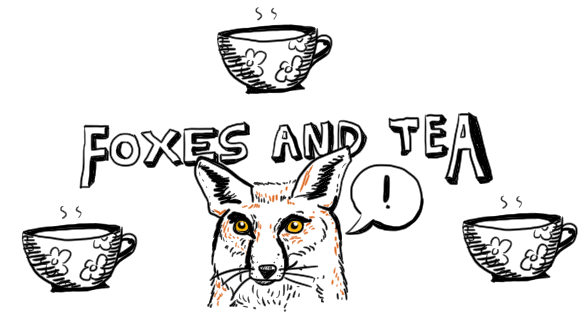
Liz started her art blog, Foxes and Tea, back in 2012. Last year, in March 2015, she decided to take the leap and set up an account with Society6. Here she shares an insider’s thoughts on the service, and her experiences of her first year running an online shop.
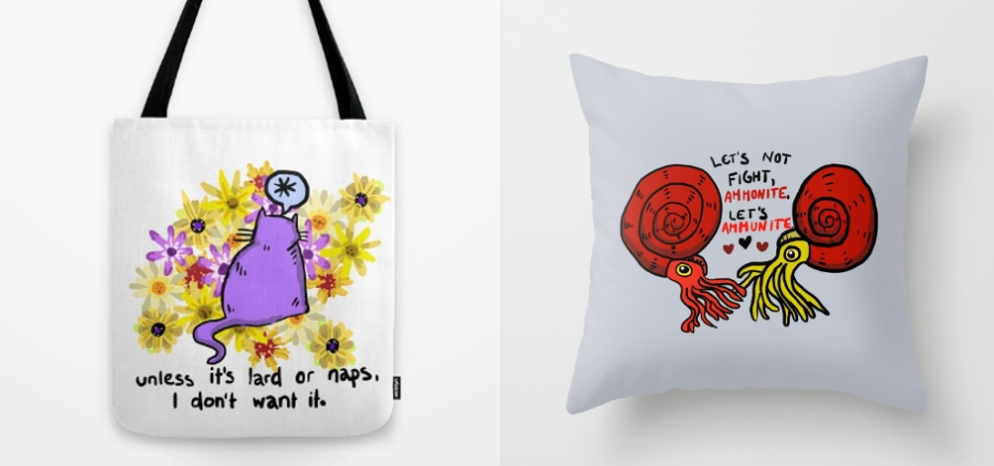
Liz sells quirky animal and history themed designs through her Society6 shop, Foxes and Tea.
1. Hi Liz. What made you decide to sell your art through Society6?
“I saw that other artists were doing it, and I liked the range of products that Society6 offers. And I’ve always enjoyed designing t-shirts – even when I first started messing around with Photoshop at 14, I’d be like “yes, this will make the coolest shirt.” (Spoilers: none of those early designs were very cool at all.)
I was also attracted to the fact that Society6 is quite simple, in that I just have to upload the image files and not mess about with shipping and handling or any sort of customer service.”
2. What’s the user-experience like?
“For the most part, it’s pretty easy to use, other than it keeps deleting my wishlist. But that’s more of an issue for me as a consumer, rather than as a seller.
In general I’ve found they offer the right tools for me to edit my designs when adding them to items, although they don’t have an option on the website to crop/edit images. But that’s a minor inconvenience at most.
I like the fact that you get an immediate preview for what the product looks like. I also like that I don’t have to deal with the shipping, or with things going wrong. Society6 has its own customer service department for stuff like that, and when I’ve spoken to them they’ve been really prompt, and really friendly.”
3. Which product seems to have sold best for you, so far?
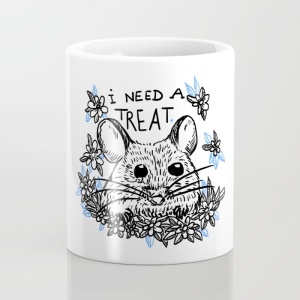
“It’s mugs, hands down.
Which might be because they’re some of the cheaper products, or because mugs are amazing.”
Liz admits to having a mug problem.
4. What challenges do you face by selling through Society6?
“Some people can be put off by the price – it definitely isn’t cheap. I’d always wait for a sale to be on before buying anything. (I’d really like to get one of their throw blankets, but they’re all a bit too expensive for me to justify it.)
In terms of profit, you potentially get a smaller cut than if you were producing and selling the same items independently. But I don’t mind this, because I can just upload my designs and then forget about it. It would be different if I was trying to make those sales my primary income.
Another downside is that your artwork is only included in the general search if the customer has previously looked at it in your shop. It won’t automatically be included in the site-wide Society6 shop, so you have to provide direct links to make sure the customer sees things in your personal shop-front first.”
5. Would you recommend using a shop like Society6 to an artist in a similar position to yourself?
“Well, you haven’t really got anything to lose by doing it.
It’s not going to make you rich over night (unless maybe you’re selling the world’s most amazing fan art, and it’s coming up to Christmas) but it also requires no investment, apart from time.”
6. What advice would you give to someone setting up their own shop?
“First of all, tag your art, so people will actually find it. (But don’t put like twenty billion tags on it, cause that’s just silly.)
Secondly, make all the image files for products you’ll want to sell in one go OR take care to keep the original file, in case you want to add more products later. Remember that different products need different file dimensions (e.g. shirts have to be 3300 x 5100 pixels, whereas mugs are 4600 x 2000). Nothing is more annoying than if you want to add say, a mug, but the only file you have is 1000 x 1000, and you just end up with loads of white space on the product.
This also seems like a good time to plug Mischief, which is AMAZING for scalable vectors (and cheap/free with limited features).”
7. As well as your Society6 shop, I know you also sell art commissions independently – how does that compare to shop sales?
“I sell fewer commissions than shop products, but tend to receive more money for them. A small Society6 print and a commission might actually cost the same, but I receive a bigger cut from the commission. A lot of the time I also charge slightly less than Society6 prices and still receive a larger profit.
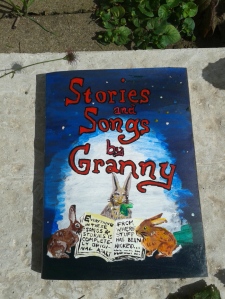
I might not be able to make the same products as Society6 by myself, but I still do a fair range. I’ve done some traditional art (a painted book cover, watercolours, pencil drawings) and I’ve done digital stuff (RP characters, portraits). The advantage of commissions is that you can talk to the buyer and give them exactly what they want.”
One of Liz’s commissions. ‘Everything in these songs and stories is completely original apart from where stuff has been nicked…’
8. You’ve said already that this isn’t your primary income. It’s important to be realistic when diving into an endeavour like this, so can you give us an idea of how your art sales fit into your wider earnings?
“Well, I’m a scummy PhD student, so I support myself with the occasional temp job, whatever money the university deigns to give me, and my parents if they’re feeling charitable.
My art goes into what I call my lard fund. I might buy a treat for myself with it, pay for a conference fee, or make up money if I really can’t afford a bill.
I also quite like my degree, and would defo like to work in some related field. If I could combine art with my degree, and become some sort of mad painting professor, that’d be ideal.”
Thanks for the insight, Liz. To sum up what you’ve said about using services provided by a company such as Society6 . . .
The pros:
Easy to use
Takes manufacturing, shipping, and customer service out of your hands
A large variety of products to put your designs on
No money required upfront
The cons:
Expensive base prices set by the company
Smaller profit margin than if you sold independently
May be difficult to get discovered by new customers
There are certainly people out there who shout about their success using shops like this – Zazzle’s forum has a few threads from people who claim to have quit their day job and run a shop full-time – but it’s important to understand that these are the exception to the rule. If you’re determined to use something like this as your springboard, then you need to accept that you’ll start out very small and it takes a huge amount of work and persistent marketing to build up to anywhere near the ‘full-time’ kind of success.
If ‘full-time’ is what you’re after, then you might be better off setting up your own independent online shop. If you have the time, and perhaps more importantly the money to manufacture your products independently, then you may be more likely to see a better return on your investment if you go it alone, and you can have true control over all aspects of your business.
But if you’re someone without the time to pour into managing a host of product manufacturers, website maintenance, sales contracts, worldwide shipping, and all the customer service issues that come with running your own business . . . or if, like Liz, you’re a passionate artist after a lard fund or rent top-up . . . then a shop like Society6 might be for you.
Thanks to Liz for sitting through my questions. If you like her art you can see more on her blog or visit her online shop.
We hope you found this helpful. Do you run a shop like Liz’s? How does your experience compare? Any tips for others? Let us know in the comments!
Since my last blog post I’ve been doing a lot of reading into how one goes about reaching an audience for their episodic stories . . . and I’ve learned that there are no clear-cut search terms to help navigate the topic, and no clear definition of what this form of writing actually is. And part of the reason, I think, is due to the digital age we live in, where eBooks and self-publishing have expanded the possibilities open to authors today.
At its simplest, episodic or serial fiction is a narrative presented in separate installments over a period of time. But that’s about as specific as defining a novel as a book with words in, and this vagueness of meaning seems to be frustrating readers in various corners of the internet who perhaps didn’t know exactly what they were buying into when the author described their work as ‘episodic’.
Below I’ve attempted to collate my own understanding of the two main types of serial fiction, and the challenges faced by both readers and writers using the form.
The Serialised Novel
With the availability of e-publishing, a lot of authors are now experimenting with serialising their novels. This means the author has written (or is in the process of writing) one complete story which can be broken up and sold as stand-alone segments. Sometimes these segments have been designed with serialisation in mind, ending on a cliff-hanger to keep the reader hooked waiting for the next installment; sometimes the installments are just normal chapters released for sale separately over time. This means the author can charge a small amount, say 99p, for each individual segment or chapter, potentially making more money than if they’d just sold the complete novel on its own. As a plus, readers might be persuaded to also buy the completed novel in order to have the story sections collected together.
Ultimately, a serialised novel can be presented equally well as a novel or as a series. But it has a relatively short run, to the length of an average novel in its genre.
From my Googling efforts and conversations with friends and family, I get the impression that most people, when talking about ‘serialised fiction’, are referring specifically to serialised novels. This frustrated me no end when I was trying to find advice tailored to the kind of serial I like to write, which is:
The Episodic Series
I would liken this form to a television series. The individual installments are more likely to stand up on their own within an episodic series, much like how you can watch a single episode of Supernatural or Game of Thrones without having seen the rest – you might not get to grips with all the character background and world lore, but you’ll be able to follow the plot that’s presented directly in front of you for the course of that episode. (You won’t understand why it was important that so-and-so’s dad killed so-and-so’s aunty five years ago, but you’ll understand why the character you only just fell in love with was horrifically murdered in this episode with nary a warning. And then you’ll curse George R. R. Martin and resign yourself to watching the series from the beginning.)
In this sense an episodic series is often longer and more likely to be without a fixed end. It might be composed of wildly disparate settings and characters, but be tied together by an underlying motif or intertwined plot. An episodic series also has the potential to be divided into seasons, where a set of episodes are bound by one overarching plot arc. E.g. There are twenty episodes that make up Season 1 of the Jack Hansard Series.
Whereas a serialised novel is a complete story that has been broken up, an episodic series is a story that is constantly unfolding with each episode and could (potentially) continue unfolding infinitely. Y’know, just like a beloved TV series that jumps the shark and goes on way, way too long. (Lookin’ at you, Supernatural.)
Here I feel it makes sense to call the installments ‘episodes’, whereas the installments in a serialised novel could sensibly be called ‘chapters’ or ‘segments’. Crucially, I feel the key thing about an episodic series is that it would not work as a novel. I’m not saying you couldn’t edit and adapt it into novel form. I mean that if you collected a season’s worth of episodes together, it would still read as a season of individual (though connected) stories, rather than as one story where all the segments run seamlessly into each other.
I don’t claim to be a pro, and the definitions I’ve given are hardly rigid. Even my Jack Hansard only loosely fits, as not every story can be consumed separately from the rest: because I’ve restricted myself to very compact installments (4000-5000 words a piece) some stories spill over into several episodes, so that the overall series contains mini-arcs of three to five episodes long. But again, I’d liken it to a TV series, where script-writers will often create two-part episode arcs to build suspense.
Do People Read Serials?
Short answer: YES, and then some.
Nowadays it’s easier than ever to access serial stories: you can buy them easily through Amazon and other e-publishing services; read them on your phone, tablet or Kindle. Websites like Wattpad offer a free platform for readers and writers of all types of serialised fiction, and the idea seems to be pretty successful: with an audience of 45 million readers a month on Wattpad, it suggests there’s plenty of demand for this form of writing. But whether serial fiction is a good or bad idea varies from reader to reader, and probably depends on how much you enjoy the anticipation of waiting for the next installment to arrive – and how effectively authors present their work.
Image attribution: Wattpad
For instance, the self-publishing platform Smashwords has been decidedly lukewarm to the concept of serial fiction, and although serials are recognised as a viable form in their Terms of Service, there’s a handy section that declares a publication must not be an “unfinished work-in-progress”. Y’know, a definition you could easily apply to an episodic series if you didn’t want them hanging around, cluttering up your webpages.
I can understand why. In the past some authors have abused the system and annoyed readers by flooding an online shop front with images of their multiple ‘serial’ works, instead of a solitary entry for a novel. A cheap trick to get attention. Readers have also explained their dislike of having to pay for separate installments, seeing it as a tacky device to make them pay more for each chapter. Sometimes this negativity is because the reader didn’t understand they weren’t buying a finished story at point of purchase, or because they jumped in halfway through a series by accident.
So what can we do, as writers, to help readers enjoy the serialised story form? More than anything, I think we need to be clear about what we’re selling. If you’re selling chapters of a book that you’re eventually going to release as a completed novel, be upfront about it: readers may prefer to wait and pay for the finished deal. Letting them know they have a choice matters, and hopefully curbs feelings of ‘I’ve been cheated’ from those that don’t enjoy cliff-hangers or the anticipation of waiting.
If you’re selling an episodic series, I think you need to start by explaining exactly what that is, in relation to the story you’re presenting. It’s going to suck balls if the reader thinks they’re subscribing to a series of novels and then receives short stories for their money. Will you be releasing a collected ‘season’ of your episodes, so that readers don’t have to buy them separately if they don’t want to?
In particular, we need to avoid the temptation to abuse the episodic form for attention. Don’t upload all your episodes at once to spam a reader’s page. If you promise to update to a schedule, meet your deadlines. Even if you are charging a pittance for each installment, make sure it’s still worth the price, and if you use cliff-hangers keep them inventive and thoughtfully planned – not thrown in at the last second to keep your reader dangled on the line.
Now more than ever I think episodic storytelling is coming into its own. With our busy, frantic lifestyles and device-addiction, it makes sense to present stories in easily-digested chunks that can be served up during a long train commute or snatched during a coffee break. When people are finding they have less time to read, we can try to make the reading easier for them.
Was this helpful? Do you agree with my definitions of serial fiction? Perhaps you have a completely different understanding of how it works, or a better idea of how to classify it – let me know in the comments! =)
A friend of mine writes this cracking blog with great tips for writers (and most recently some fascinating travel articles from Berlin). Here she addresses a topic that crops up a lot in my blog – the inherent fear in writing – and she offers some great advice to tackle it.
I’ve had this site set up since Christmas. I spent ages choosing my layout, the exact shade of colour I wanted as my background, my header and tag line. The next six months I stared at a blank page and thought to myself “Ah, well I don’t have time this week. There’s that important paper I have to write… and that book I’ve been meaning to read… maybe next week.”
It’s quite scary getting your writing out on the big wide web, where it can be criticised and talked about. What if I’m not as good as I thought I was? What if it doesn’t get any views? What if I’m a failure? I think the fear of failure is one of the biggest challenges to over come, even overcoming the fear to start an introduction blog post to a community who probably won’t find it until I’m several, more…
Now that Season 1 of Jack Hansard is complete, this seems like a good time to take a step back and reflect on the lessons I’ve learned over the past year and a bit. I’ve made plenty of mistakes, and the beautiful thing about mistakes is that they cause you to evaluate the way you work and the way you write. And, crucially, they make you figure out how to do it better next time.
So I present to you the mistakes I made and the lessons I learned from them. Although Jack Hansard is only a free series I publish for fun, these same lessons are applicable to all kinds of serial or episodic writing. Whether you’re publishing webcomics, writing weekly articles for an online magazine, maintaining a daily blog, serialising your novel or working on a short story series, I hope you find some useful pointers here.
Give yourself enough time to write.
I gave myself two weeks to write each Jack Hansard episode. It was just enough time to fit in around my job. I know there are writers out there who seem to be able to churn out a thousand words a day on top of working 40 hours a week, but I’m not one of them. And that’s okay. The important thing is to know your limits, and my limit is one Jack Hansard episode – or about 4000 words – per fortnight. Any more than your limit, and you run the risk of burning out.
You should also consider the quality of your work. Two weeks is the minimum I needed to write an episode, with full proof read and some minimal editing before it was published. And no matter how hard I tried, it was never, ever perfect. Because of course it’s not. For a perfect short story, ideally you want to leave it a few days, and then come back and re-do the whole shebang. The question is how important ‘perfect’ is to you.
At first, I was okay with imperfect – Hansard’s journey was intended as more of a training exercise from my perspective, a challenge to write consistently and meet deadlines. But as the story and characters grew, I grew endlessly attached to them and wanted to do them greater justice. I have made countless edits to the Jack Hansard stories – cleaning up the little niggles, polishing here and there – but it still frustrates me that I can’t pull it all down and piece it back together so that’s it becomes even better. If I were to rewind, I would give myself at least a month to write each episode, and I’d spend more time working out how they all intertwined in the wider scheme of things.
So before you set off on your episodic journey, before you publish anything and set the clock ticking, take some time to work out how long each episode, article, or strip will take you to produce – and make peace with the schedule you set yourself, because later on you’re gunna have a lot of fights with that bastard.
Once you’ve worked out your time-table, stick to it.
I’m quite proud that I met my fortnightly deadline most of the time, even if it did result in a few episodes I wished I’d spent more time on. It proved to me that I really could work under pressure and still produce something of a decent quality.
I found my biggest set-backs came when I took some time off. Now, sometimes this is very necessary – in my case there was a funeral to attend, there was a massive adventure in Belgium, and there was Christmas reserved for friends and family. There’s no reason not to take these times off – if anything, I’d recommend that you build a holiday into your timetable so that you don’t burn out during periods you know you’ll be too busy to fully commit. But where I went wrong was in not setting a proper ‘return-to-work’ date. Particularly after Christmas, this was a deep holiday hole I fell down where a long stint away from writing the series left me very complacent and lacking enthusiasm.
My key advice would be to keep your holidays short. And just because you’re having time away from the series, doesn’t mean you should have time away from writing altogether. Try using the time to pursue other projects, or enjoy writing just for the sake of it – anything to keep your eye in.
And how can you make your brief holidays easier on both yourself and your readers?
Get started before you start.
Before I launched An Inspired Mess and Jack Hansard, I’d already written the first two episodes to give myself a head start. And, even more cunningly, I’d written two future stories (which became Episodes 11 and 16, both sparking their own sub-plots lasting several very fun installments).
These future episodes were there to give me breathing space, to cover my ass if I couldn’t finish the time-tabled episode in time, in case a family emergency came up, and to provide content during my planned ‘holiday’ in the middle of the series.
All very good in theory. My mistake: I didn’t use my breathing space. I should have kept at least one episode ahead, but I didn’t. If I had, there wouldn’t have been month-long gaps in the summer and winter where nothing was uploaded.
So make sure you have several stories or articles written before you publish the first one, and save one or two for those unexpected gaps that will undoubtedly crop up.
On the subject of planning . . .
Keep notes.
Other people might say ‘make plans’, but I say that’s up to you. Best-laid plans work for some, and the advantages of knowing the plot in advance are obvious. But I’m someone who prefers to plan off the cuff – I’ve the rough plot for the next three episodes, and a vague sense of the overarching story, but I don’t want to be hemmed in by details. The brilliant thing about a short story series is that some very unexpected details can unfold if you just go with the flow and allow the series to take a different direction from time to time.
But if you don’t write plans, write notes. These are those unfolding details that might become very important later. So you just introduced a side-character who you whimsically gave a sense of humour that revolves entirely around fish puns . . . five stories later a joke about a haddock might end up the turning point of the whole plot. Or perhaps it’s the colour of his eyes? Her eyes? Damn, where did our main character meet this person again?
Going over these little details can also help you in times of Writer’s Block, as well as in tightening your overarching storyline. If you’d forgotten that one particular character loved fish puns, reading over the notes could spark that very turning point in the plot.
I was a lousy note-taker, and I wish I’d created a binder full of them for easy reference. Instead I found myself leafing through the hand-written drafts and scanning the published episodes for references to personality quirks and physical descriptions I couldn’t quite recall. In particular, the way Ang speaks – I was constantly referring to the Coblyn’s previous dialogue to refresh my memory. Character profiles: wish I’d bothered.
If your episodic writing is more non-fiction based, I would still suggest keeping notes of the subjects you’ve covered. Say you blog about a different 80s glam metal album cover each week – you probably want to keep a record of what you’ve featured so far, and a list of your favourite words for describing fabulous hair.
Fabulous hair.
And finally . . .
Keep going!
Remember to believe in yourself, and the fact that your work isn’t as terrible as you sometimes think it is. Show it to your friends and family and believe them when they tell you they like it. If they don’t – take on board their advice, it’ll only make you stronger. And it’ll make them more invested in helping you; they’ll care aboutyour work when you show that you care about their opinion.
I wouldn’t have got this far without my fiancé nagging me in the background. Even though my genre isn’t really his cup of tea, he’s dutifully proof read and mercilessly criticised all of the Jack Hansard series for me (and half of these blog posts, too). He gave me the push (shove) I needed to get that final episode done when I was suffering from prolonged Christmas/New Year’s/Springtime/GotANewJob blues (read: excuses).
So find someone, or a group of someones, who you can rely on to give you that extra little push when you’ve lost your mojo, and remember that a bit of tough love and self-discipline will get you further than you expect.
If you have any tips of your own I’d love to hear them – just leave a comment below. Take care y’all.
I suppose we should have a quick retrospective. An Inspired Mess and the Jack Hansard Series launched way back in January 2015. I published one episode roughly every two weeks – sure, I took a short holiday in the middle, and the beginning of this year suffered a blip as I got engaged and started a new job – but broadly speaking I’ve accomplished what I set out to do: finish what I started. I said I’d get to 20 Episodes, and I have. Suck it, stage fright.
Through Jack’s ridiculous misadventures we’ve encountered monsters in abundance, magic aplenty, mayhem galore . . . and we’ve topped it off with an epic showdown between gods, humans, and one quiet-eyed femme fatale. And, of course, the little Welsh coblyn.
What the future holds, I’m not quite sure yet. Do I continue on into Season 2? Do I adapt the existing stories into a different format? Do I continue staring at my laptop saying ‘What do I do?’
Whatever the case, Hansard is too big in my head to just go back to sleep. There’s a definite future out there, and I’m looking forward to exploring it.
As for you guys . . . the main thing I want to say is thanks. Thanks for sticking with me, and making this a worthwhile endeavour. I hope Hansard has been as entertaining for you as he has for me. If you like what you’ve read of the series, or have some thoughts on what I should do next, leave me a comment – you’ll undoubtedly influence my decision in some way or other. And I’d be just utterly chuffed to hear from you.
If you want to keep updated on what happens next, give that big old ‘Follow’ button a click. Or if you prefer, hit me up on Facebook. I hope we see each other again. Take care!
A monumental event occurred in my life today. I was rejected by a leading Science Fiction magazine.
Wait, what?
You heard (read?) me right. At the top of my inbox, only three hours after I’d checked the online status of my short story (‘Under Review’), a nondescript email arrived with the news that my submission was not accepted.
And it made me happy.
“Dear Georgina,
Thank you very much for letting us see “Sleeping Mother.” We appreciate your taking the time to send it in for our consideration. Although it does not suit the needs of the magazine at this time, we wish you luck with placing it elsewhere.
Sincerely,
*******, Editor Asimov’s Science Fiction”
Nothing special. Fairly impersonal, no critical advice offered; of course not, because editors don’t have that sort of time to spend on every budding would-be in their slush pile. So why did it strike such a chord?
This is the sort of news that’s meant to knock a writer to the floor with doubt and self-pity. It’s meant to rock your belief in yourself and the skills you thought you possessed. It’ll make you angry with yourself and question why you even bother writing this dumb shit anyway.
Yeah, I was actually worried those things would happen. I knew, after all the online articles and advice columns I’ve read, that it would be highly unlikely for my very first submission to get accepted. I knew to expect a rejection. But I still kinda dreaded it.
Problem is, that kind of dread can lead to inaction, which can be even worse than self-pity. I’ve been writing since the age of at least ten, maybe younger. I’ve got these cute exercise books full of my ridiculous, badly-spelled, early fiction. By the age of fourteen I knew I wanted to be a published author, and I’ve had that goal in the back of my head ever since.
Funny how it’s stayed at the back for so long, where it’s safe and comfortable.
I made some small, tentative steps – short story competitions, writing forums, even the Jack Hansard series has been arguably tentative. Not once have I approached a professional market, taken myself seriously in a professional capacity… until now.
Ultimately, I feel happy with this rejection because it’s my very first one. First blood. A rite of passage. Proof that I’ve crossed some invisible barrier in my head. Proof that, actually, rejection isn’t all that bad. That rejection, if anything, should make you work even harder.
First thing I did was review my manuscript and make changes. Re-read formatting guidelines. Tightened sentence structure. And then I went to the next magazine on my list, and submitted to them. I feel it’s worth a second opinion.
But while I wait for a reply, I’m going to give the story an overhaul, and make it kick even more ass. It might take another ten, twenty rejections, but eventually I’m going to end up with a story that kicks so hard somebody is going to have to help pick the editor up off the floor.
I want to frame my first rejection and stick it on my wall, and it will sit there as a reminder that there’s no reason to be scared of taking that step, because literally the worst thing that can happen is that you make yourself a better writer.
Sure, I know that sounds easier said than done. It’s one of those things that can’t really be taught – only you can make the changes required by improvement, and only you can make yourself want to pursue that difficult road. But there are some small nuggets of advice and encouragement we can share among ourselves. For my money, after a rejection (and, in fact, before you consider submitting anything, anywhere) an easy first step is to check your manuscript has been formatted correctly. It won’t save a poorly written story, but it might stop a good one sliding out from under the editor’s gaze. They do a crap-ton of reading – so make it easier on the eye for them. For an excellent guide, I sincerely recommend William Shunn’s comprehensive, and above all illustrative guide to achieving the industry standard: http://www.shunn.net/format/story.html I’d read descriptions of correct formatting elsewhere, but missed crucial elements until I saw it laid out clearly on the page like this.
I would then recommend reading this article by Sarah Olson for some seriously helpful and down-to-earth advice from slush readers. Even if you’ve heard all this advice before, it’s still incredibly interesting to get an insider perspective. I wouldn’t have guessed that cannibalism themes were apparently so prevalent. Or that starting sentences with ‘It was…’ can be a major turn-off for some editors. They’ve read it all before. Our job is to find the uncommon denominator.
And finally, keep writing, and don’t lose faith. A rejection doesn’t mean you’re a bad writer. It might mean you misjudged the market, or you landed the editor who has already read several alien invasion stories that day, or that your work was good, but not the best. So keep writing until you are the best, and don’t let dread get the better of you. And frame that rejection letter. Wear it as a point of pride.
Merry Holiday-Of-Your-Choice from me and all the gang! Just about managed to Lego-ify them accurately – there was a distinct lack of blue hair for Peggy and Coblyn-like clothing for Goron and Ang. Let’s say they were bribed with pies to dress as elves.
If you want to have some fun Lego-ifying yourself or your own characters, you can do so here.



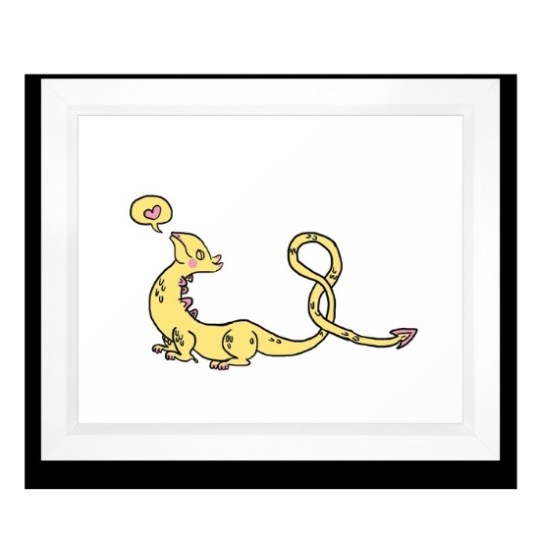
 We hope you found this helpful. Do you run a shop like Liz’s? How does your experience compare? Any tips for others? Let us know in the comments!





 I’m quite proud that I met my fortnightly deadline most of the time, even if it did result in a few episodes I wished I’d spent more time on. It proved to me that I really could work under pressure and still produce something of a decent quality.
 Before I launched An Inspired Mess and Jack Hansard, I’d already written the first two episodes to give myself a head start. And, even more cunningly, I’d written two future stories (which became Episodes 11 and 16, both sparking their own sub-plots lasting several very fun installments).
 Other people might say ‘make plans’, but I say that’s up to you. Best-laid plans work for some, and the advantages of knowing the plot in advance are obvious. But I’m someone who prefers to plan off the cuff – I’ve the rough plot for the next three episodes, and a vague sense of the overarching story, but I don’t want to be hemmed in by details. The brilliant thing about a short story series is that some very unexpected details can unfold if you just go with the flow and allow the series to take a different direction from time to time.
 Remember to believe in yourself, and the fact that your work isn’t as terrible as you sometimes think it is. Show it to your friends and family and believe them when they tell you they like it. If they don’t – take on board their advice, it’ll only make you stronger. And it’ll make them more invested in helping you; they’ll care about your work when you show that you care about their opinion.

 Georgina Jeffery